A friend Went to a Korean Pharmacy for Skincare. Things Escalated.
PDRN, exosomes, PLLA, PDLLA, human extracellular matrix... and the increasingly blurry line between skincare and regenerative medicine
My friend went to Korea.
I was not in Korea.
I was, however, on the phone with her while she was in a Korean pharmacy, enthusiastically telling her what to look for.
She was physically there.
I was emotionally there.
And possibly more invested in the shopping than she was.
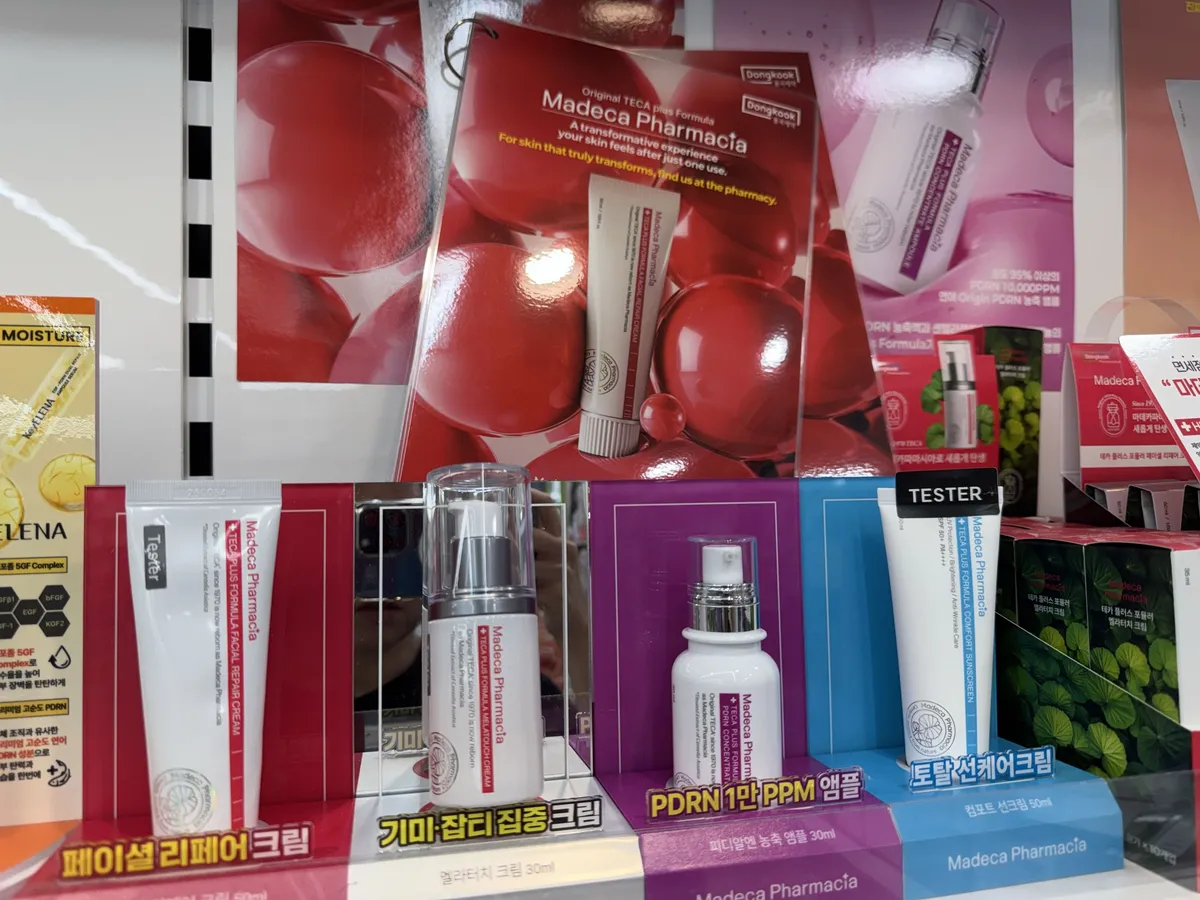
And then there was an entire Madeca Pharmacia section, just casually sitting in the pharmacy.
This was supposed to be simple.
"Can you have a look for some Korean skincare while you're there?"
My friend was having an absolute blast helping me shop through photos, happily sending me pictures from the pharmacy while I sat at home in a state of complete skincare delirium.
She would send a photo. I would zoom in. I would spot something else.
"Wait. Go back."
"What's that?"
"Can you photograph the ingredients?"
"And what's THAT?"
I was trying to look at everything as fast as humanly possible, typing questions and firing messages back at her before she moved on to the next shelf.
She was having fun.
I was having the time of my life.
At some point this stopped being a shopping trip and became a remote pharmaceutical reconnaissance mission.
She was happily taking photos.
I was deliriously trying to keep up.
And between us, we somehow ended up with photographs of PDRN, PN, repair products, EGF and various things that sounded suspiciously like they belonged in a regenerative-medicine laboratory.
Naturally, I had questions.
Because Korean pharmacies are not quite pharmacies in the way I was expecting.
You can walk in looking for something completely ordinary and find shelves full of pharmaceutical skincare, aesthetic products and ingredients that have somehow travelled from medical research into beauty.
PDRN, PN, exosomes, PLLA, PDLLA, placenta...
And increasingly, things that sound like they belong in a regenerative-medicine lab.
And now there's human acellular dermal matrix.
Not quite skincare yet, but Korea is already injecting it into skin.
hADM is human dermal tissue that has been processed to remove the cells, leaving an extracellular-matrix scaffold containing things such as collagen and elastin. Products such as Re2O are being used as injectable ECM skin boosters in Korea.
So we're not quite at human skin moisturiser yet.
But we've definitely moved beyond PDRN creams.
At some point you have to ask:
When did skincare start sounding like a regenerative-medicine conference?
First, there are two very different pharmacy experiences
The Korean word for pharmacy is 약국 (yak-guk).
The traditional pharmacy is usually small and pharmacist-led. You explain what you need, and the pharmacist recommends something.

The traditional Korean pharmacy: small, pharmacist-led and very different from a Western beauty store.
Then there is the newer phenomenon: the warehouse pharmacy.

The warehouse pharmacy: because apparently we needed a Costco for medicines and skincare.
Think Costco, but make it a pharmacy, add shopping trolleys, and fill the shelves with medicines, supplements, skincare and health products.
Suddenly you've got somewhere you can accidentally spend an hour comparing seven different repair creams.
Or, in my case, somewhere I can send my friend while I conduct the entire shopping expedition remotely.
And this is where things get interesting.
The skincare rabbit hole
PDRN
You've probably heard of PDRN, or polydeoxyribonucleotide.
It's made up of DNA fragments and has become strongly associated with skin repair and regenerative aesthetics in Korea.
What fascinates me is how far the idea has travelled.
It started in the medical and aesthetic world, then came skin boosters, then topical products.
Now you can walk into a Korean pharmacy and find PDRN products sitting on the shelf.
That's quite a journey for something that sounds like it should still be sitting in a research paper.
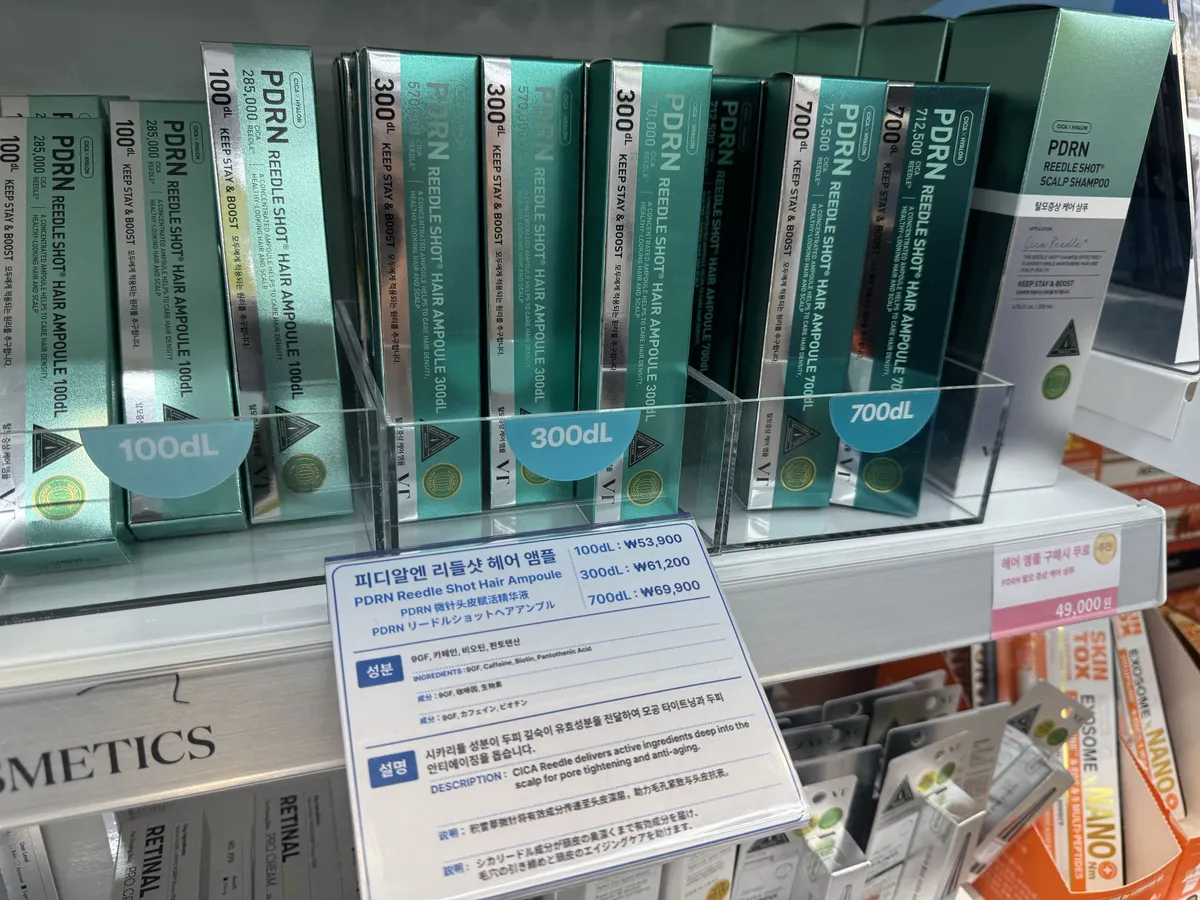
PDRN Reedle Shot Hair Ampoules in 100, 300 and 700 dL formulations. Because apparently the rabbit hole has a scalp department too.
And PDRN isn't alone.
PN and exosomes
Then there's PN, or polynucleotide, which you'll often see discussed alongside PDRN.
And then there are exosomes.
Exosomes are tiny extracellular vesicles released by cells. They can carry proteins, lipids and nucleic acids involved in cell-to-cell communication, which is exactly why regenerative-medicine researchers are interested in them, and exactly why the beauty industry is interested too.
But this is where we need to slow down.
A cream containing an exosome-related ingredient is not the same thing as exosome therapy.
Likewise, a product saying "stem cell" on the box does not mean there are living human mesenchymal stromal cells (MSCs) floating around in your moisturiser.
Please do not wait for a tiny MSC to climb out.
Read the ingredients.
And then there was EGF
At this point I was already enjoying myself.
Then my friend sent me this.
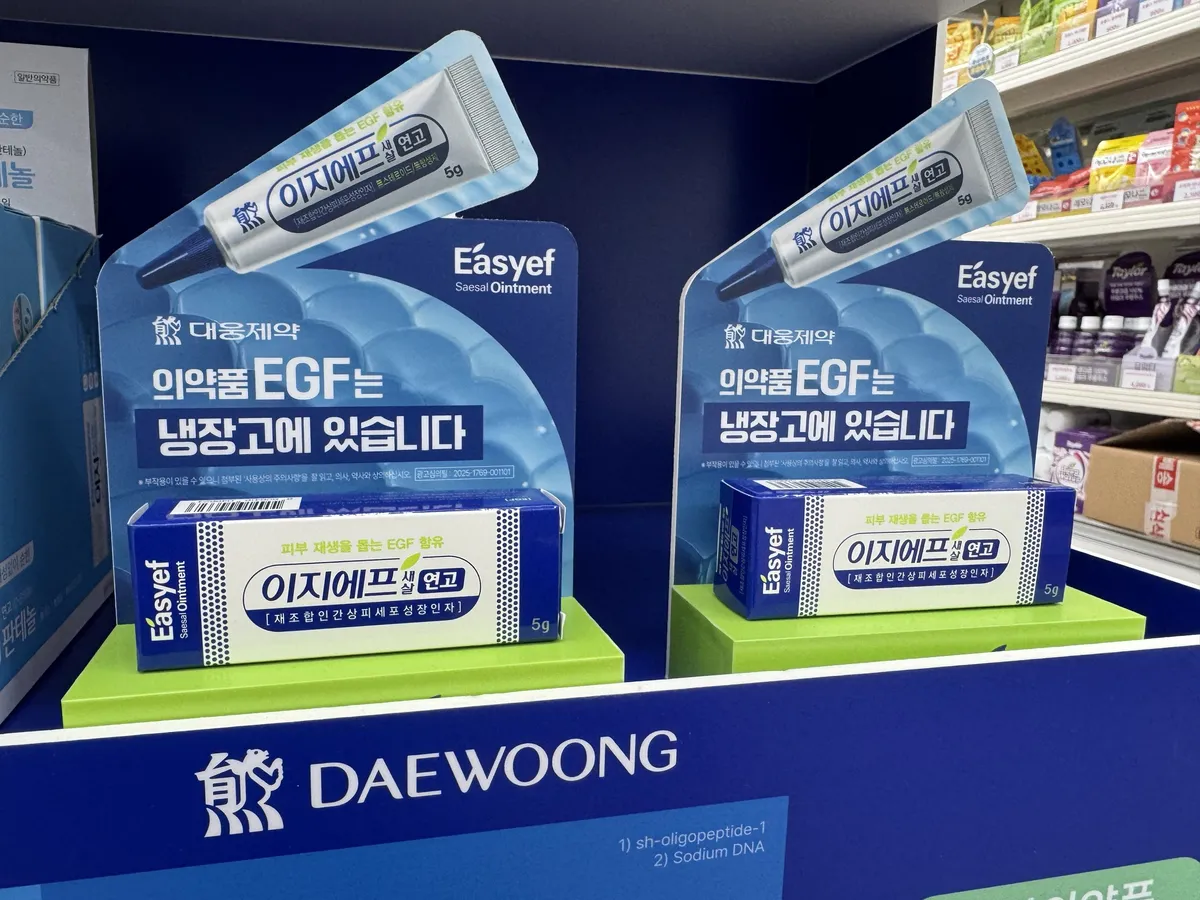
And then I found EGF sitting in the pharmacy fridge. Apparently this is normal now.
EGF.
Epidermal growth factor.
A signalling protein involved in cell growth, proliferation and wound healing.
And suddenly we're looking at something that sounds considerably more like biology than beauty.
This is one of the things I find fascinating about Korean pharmacy skincare.
The ingredients aren't necessarily new.
The interesting part is where they've ended up.
Things that were once discussed in wound healing, tissue repair and cell biology now appear in products you can encounter during an afternoon pharmacy run.
Then we get to collagen stimulators
And this is where Korean aesthetic medicine starts moving away from conventional skincare entirely.
PLLA
Poly-L-lactic acid, or PLLA, is a biodegradable polymer used as an injectable collagen stimulator.
Instead of simply adding volume, the idea is to encourage the tissue to make more collagen over time.
So we're officially leaving skincare behind.
We're talking biostimulation now.
And then there's PDLLA.
PDLLA
Poly-D,L-lactic acid, or PDLLA, is another form of polylactic acid used in injectable aesthetics, and it's becoming increasingly interesting in Korean aesthetic medicine.
The interesting thing is that PDLLA isn't staying injectable.
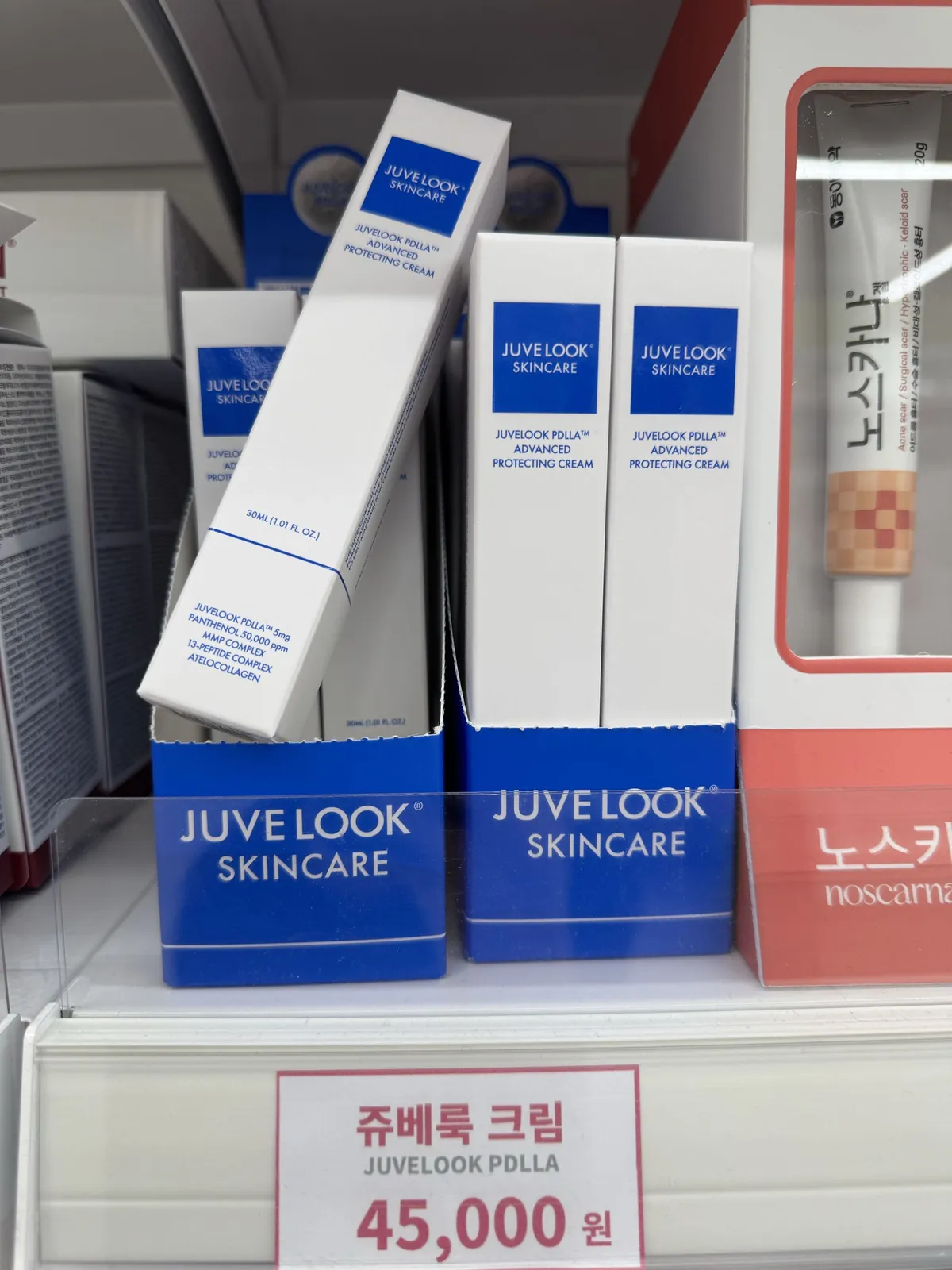
And then my friend found this. Juvelook has now taken the PDLLA idea from the injectable treatment room and put it into a topical skincare product.
Which raises a rather obvious question:
Can you actually put a collagen-stimulating polymer on the skin and expect it to do anything?
That is a very different scientific question from injecting PDLLA into the dermis.
The skin barrier exists for a reason.
So while the concept is fascinating, I wouldn't automatically assume that a topical PDLLA product behaves anything like injectable Juvelook.
And this is exactly the sort of thing I want to investigate rather than simply taking the marketing at face value.
A 2026 randomised split-face study compared a PDLLA + hyaluronic acid product with PLLA for nasolabial folds. Both improved the appearance of the folds, with the PDLLA product performing comparably to PLLA over 24 weeks.
The study involved just 33 people, though, so this is interesting rather than definitive.
Now our innocent little skincare rabbit hole has gone:
cream → PDRN → exosomes → injectable biostimulators → topical PDLLA
Excellent.
And Korea still wasn't finished.
Now there's hADM
This is the bit that really caught my attention.
Human acellular dermal matrix
hADM.
Human acellular dermal matrix.
It sounds terrifyingly clinical because it is.
Human skin isn't just cells. There's also the extracellular matrix, the structural environment surrounding those cells.
It contains things such as collagen, elastin and other components that help provide tissue structure.
hADM is made from donated human dermal tissue that has been processed to remove the cells, leaving an acellular matrix.
Korea is now taking this concept into aesthetic medicine.
One example is Elravie Re2O, an ECM-based injectable skin booster incorporating hADM. Re2O Fine was also introduced in 2026.
A 2026 randomised split-face clinical study looked at particulate hADM as a facial skin booster and reported improvements in several measures of skin quality over the study period.
Small study. Early days. But fascinating.
Because this is a different idea from simply saying:
Make more collagen.
The concept is closer to:
What if we give the tissue some of the structural environment it has lost?
That is a much more interesting question.
Will hADM become skincare?
Maybe.
But not yet in the way you might imagine.
What I can verify right now is injectable hADM/ECM skin boosters, not a conventional hADM moisturiser sitting next to the PDRN creams.
And that distinction matters.
A cream has to get through the skin barrier. An injectable material is delivered directly into the tissue.
Completely different problem.
But I wouldn't be surprised if future topical products start borrowing more from ECM biology, matrix-derived peptides and tissue-repair signalling.
Because that seems to be where the conversation is heading.
The Korean skincare rabbit hole is getting weird
If I had to map it out:
PDRN DNA fragments and repair signalling
↓
PN polynucleotide-based regenerative aesthetics
↓
Exosomes cell-to-cell signalling
↓
PLLA / PDLLA collagen stimulation
↓
ECM the environment surrounding the cells
↓
hADM human-derived acellular dermal matrix
And suddenly we're not really talking about ordinary skincare anymore.
We're talking about regenerative aesthetics.
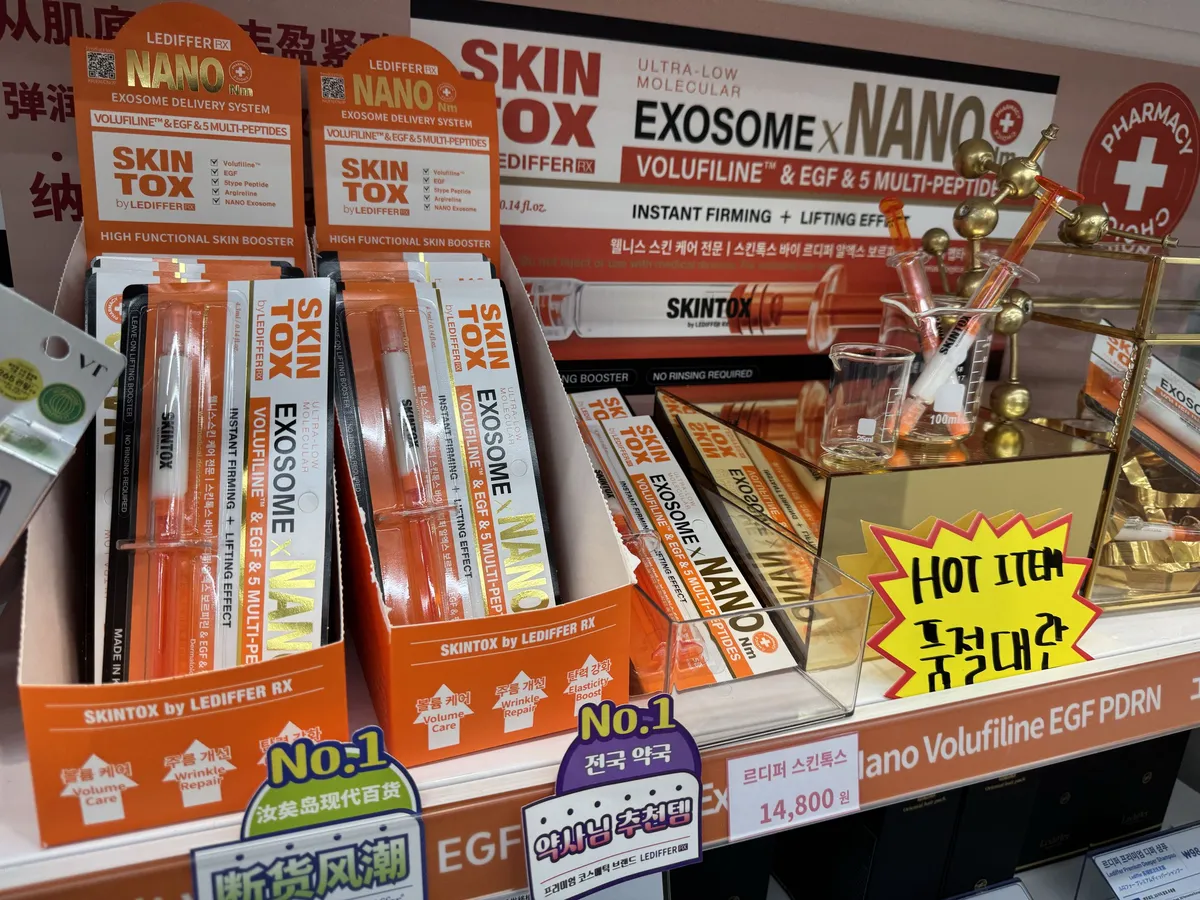
And then my friend sent me this. Skintox, exosome/Nano products, EGF and PDRN, all apparently living quite happily on the same pharmacy shelf.
I was beginning to suspect that watching my friend walk through this pharmacy had been a mistake.
Or possibly the best idea I've had all week.
So where should you go?
Myeongdong
Probably the easiest place to start if you're visiting Seoul.
You'll find pharmacies accustomed to international visitors, with specialised skincare, PDRN products and pharmaceutical-backed beauty brands.
Seongsu
For the more fashionable, beauty-meets-pharmacy version.
This is where the pharmacy starts feeling suspiciously like a curated skincare shop with a pharmacist attached.
Jongno 5-ga
For the classic pharmacy experience.
If you actually want to speak to a pharmacist rather than fill a basket, this is the sort of place I'd choose.
Warehouse pharmacies
If you want the full experience, go for the shopping trolley + pharmacy + skincare + supplements combination, and bring absolutely no self-control.
Especially if you happen to have a friend on the other end of the phone saying:
"Wait. Photograph that one too. No actually grab it. Grab 3!"
My Korean pharmacy rule
Don't buy the thing with the biggest words on the front.
Turn the box around.
Read what's actually in it.
And if it says:
STEM CELL EXOSOME PDRN REGENERATIVE
...pause.
Those words can mean very different things.
A cream isn't an injectable skin booster, an exosome skincare product isn't the same thing as exosome therapy, and hADM isn't a stem-cell treatment.
It's a human-derived acellular extracellular matrix.
Maybe the next skincare question isn't:
"What's the next miracle ingredient?"
Maybe it's:
What if we stop asking what to put on the skin and start asking what the skin needs to repair itself?
And suddenly we're talking about cells, signalling, collagen, extracellular matrix and the environment those cells live in.
Which is a very long way from buying a moisturiser.
And then there are spicules.
Tiny needle-like structures derived from marine sponges that are now being used in Korean skincare to create microscopic pathways into the skin and potentially influence ingredient delivery.
I'm going to need to look into those. 👀
C·🌷