A Mask Designed Around the Biology
What happens when PN injections meet 630-nm Micro-LED photobiomodulation?
There are a lot of LED masks. Most of them are basically: put red light on your face and hope for the best.
This one caught my attention for a much more specific reason.
A new Nano Energy study tested 630-nm Micro-LED photobiomodulation alongside PN injections.
And the interesting part isn't just the light. It's the way the light is delivered.
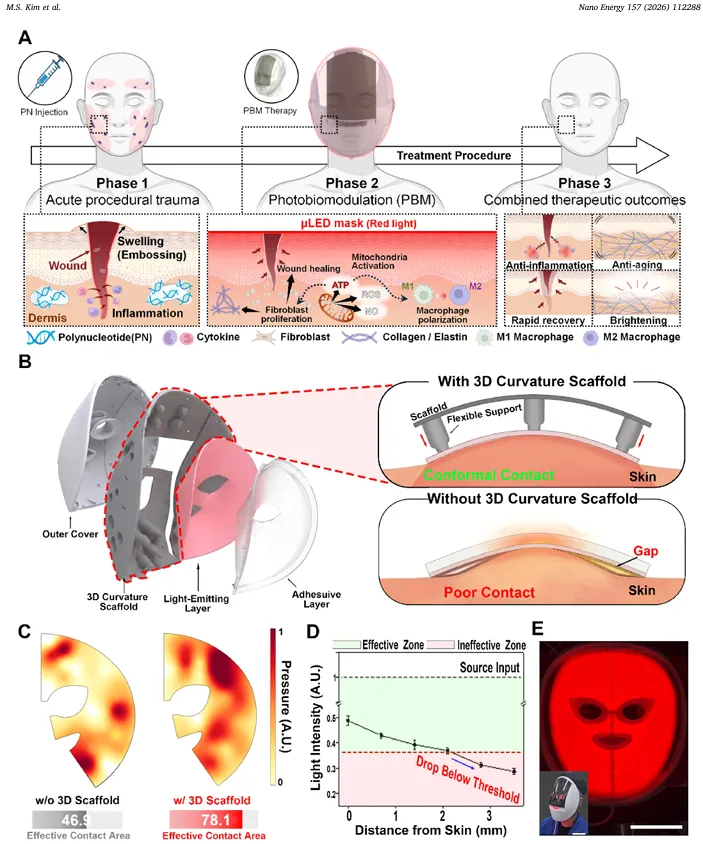
How the researchers think PN + 630-nm PBM work together
The researchers built a skin-conformable Micro-LED mask designed to follow the actual contours of the face. Its 3D scaffold pushes the flexible light-emitting layer into the forehead, cheeks, nose and chin instead of leaving large air gaps.
That matters because the study found the median source-to-skin gap could be reduced from about 4.1 mm to 1.8 mm, while effective contact increased from 46.9% to 78.1%. Light delivery was also remarkably uniform: 93.83% across eight facial positions.
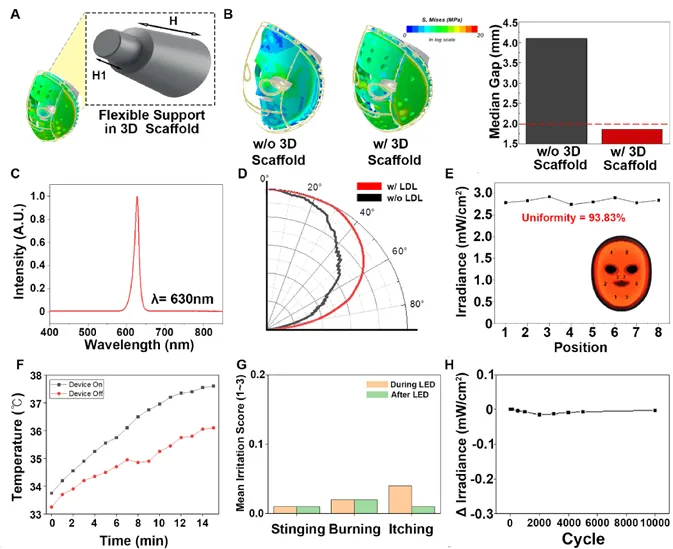
The engineering: 630 nm, close facial conformity and 93.83% light uniformity
The mask emits at 630 nm, and the surface temperature reached about 38°C after 15 minutes. In a separate tolerability test, irritation scores remained low.
But here's the part that made me stop scrolling.
The study wasn't simply testing an LED mask.
It was testing the combination.
PN + 630-nm PBM.
PN creates the injectable, matrix-supportive environment and the tiny needle-track injury. The researchers propose that 630-nm PBM then adds a different biological signal through mitochondrial and inflammatory pathways, potentially supporting fibroblast activity, ECM remodelling, recovery and pigmentation control.
And they actually tested it.
The clinical study used Rejuran Healer, 2 cc, followed by the LED treatment on only one side of the face. The mask was used for 15 minutes, five times a week for eight weeks, giving 40 sessions. The other half of the face received PN alone.
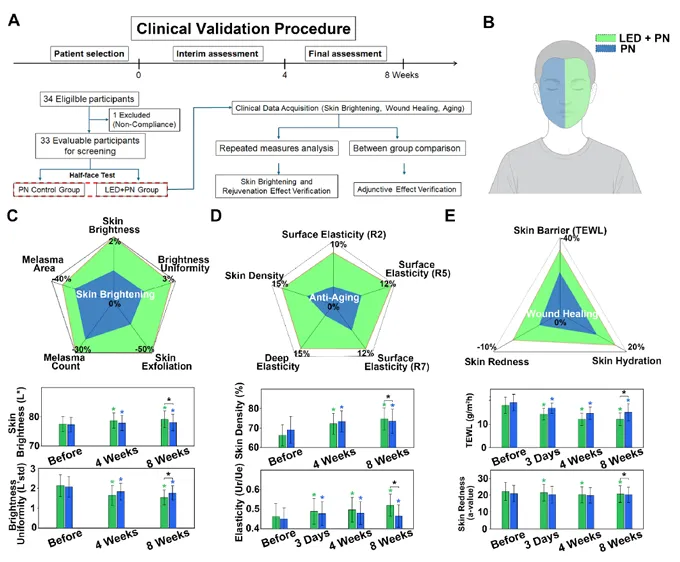
The human trial: PN alone vs PN + Micro-LED
After eight weeks, deep elasticity improved 12.8% on the PN + LED side versus 3.1% with PN alone. The LED + PN side also showed greater improvements in skin density, brightness and tone uniformity, faster barrier recovery and lower erythema.
The ex-vivo work was interesting too. Adding the LED to PN increased neo-collagen by about 15% over PN alone, while also producing stronger suppression of melanogenesis markers and lower inflammatory markers.
Why I'm interested
This is the niche part.
It sits right in the overlap between injectable biostimulation, photobiomodulation and wearable microelectronics.
Instead of thinking about PN, LED and energy devices as completely separate aesthetic treatments, the researchers are asking whether you can stack their biological signals deliberately.
That's a much more interesting idea than simply buying another LED mask.
And the engineering is what makes this particular technology interesting: 3,770 Micro-LEDs, 630-nm light, extremely close skin coupling and unusually uniform delivery.
The evidence is still early. It's one relatively small clinical study, and the authors include Amorepacific researchers. So I'm not calling this a new standard of care.
But as a piece of technology?
I'm watching this one.
For now, I'm keeping an eye on the Korean market and waiting for the price to come down to something I can justify. 😂
C·🌷
Source
Kim MS, et al. Clinical validation of skin brightening and rejuvenation enabled by a skin-conformable surface-emitting micro-LED mask with injection. Nano Energy. 2026;157:112288.