Can Placenta Actually Change Skin?
Collagen, fibroblasts, pigmentation and the rather complicated evidence behind “skin rejuvenation”
This is probably the question most people actually want answered.
We know what Laennec and Melsmon are.
We know they come from human placenta.
We know that the manufacturing process produces complex mixtures of peptides, amino acids and other biological compounds.
But what happens when those compounds meet skin?
Does anything actually change?
And more importantly, can we see that change in humans?
The answer is more interesting than a simple yes or no.
Start with the fibroblasts
If we want to understand what placental extract might do to ageing skin, fibroblasts are a sensible place to start.
These are the cells in the dermis responsible for producing much of the extracellular matrix that gives skin its structure. They make collagen, elastin and other components that influence elasticity, hydration and mechanical properties.
As skin ages, the extracellular matrix changes, and fibroblast behaviour changes with it. So researchers have been asking whether placental extract can influence what these cells do.
One study published in Scientific Reports in 2022 exposed normal human dermal fibroblasts to human placental extract and used RNA sequencing to examine changes in gene expression. The researchers found enrichment of genes involved in extracellular-matrix organisation, including COL1A1, COL5A3, ELN and HAS2.
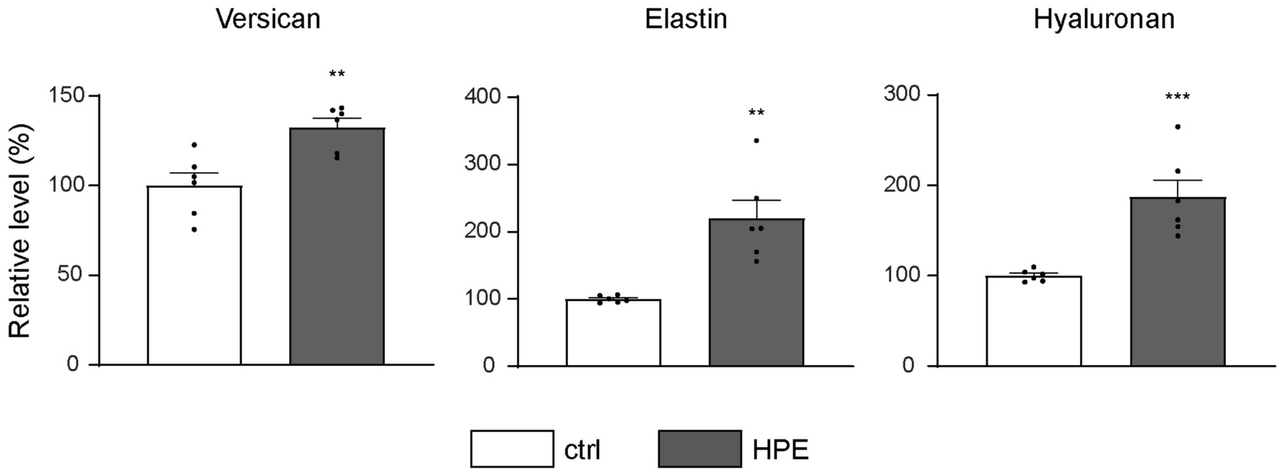
Extracellular-matrix proteins measured in cultured human dermal fibroblasts after treatment with human placental extract. From Chang et al., 2022.
They then looked at the proteins themselves and found increased levels of type I collagen, versican, elastin and hyaluronan in the treated cells.
Read the 2022 Scientific Reports study
The result is a useful piece of biological evidence, but it is also important to understand exactly what the experiment tells us.
These were cultured human fibroblasts in a laboratory. The researchers did not inject Laennec into human faces and measure collagen six months later.
So the study gives us evidence that human placental extract can influence fibroblast behaviour and extracellular-matrix biology. It does not establish the size of a clinical anti-ageing effect from injectable placenta treatments.
That distinction is easy to lose.
Collagen is not a switch
The phrase “stimulates collagen” makes the process sound much simpler than it is.
Collagen production is influenced by fibroblasts, growth factors, inflammatory signals, mechanical forces and the extracellular matrix surrounding the cells.
The 2022 study is interesting because the effect wasn't limited to one collagen gene. The researchers observed changes across a broader network of extracellular-matrix-related genes and proteins, including elastin and hyaluronan.
That suggests something more complicated than simply turning collagen production on.
The tissue environment itself may be changing.
And that brings us back to the idea of bioremodelling.
There is also a wound-healing story
Placental extracts have been investigated for much longer in wound healing than they have been in aesthetic medicine.
A 2010 study from South Korea used human placental extract in a mouse full-thickness skin-wound model. The researchers found that wounds treated with the extract decreased in size more quickly during the early healing period, with increases in TGF-β and VEGF at particular time points.
There are also human studies of topical placental extract in chronic wounds.
One clinical trial recruited 100 patients with chronic non-healing wounds and compared topical placental extract with control treatment. After eight weeks, 67.5% of patients in the treatment group showed more than 50% epithelialisation, compared with 23.3% in the control group among those who completed the study.
Read the clinical wound-healing study
That sounds impressive.
But again, there is an important difference between helping a chronic wound heal and rejuvenating healthy facial skin.
A wound is an injured biological system trying to repair itself.
Ageing skin is a very different problem.
The mechanisms may overlap in places, but they aren't interchangeable.
And then there is pigmentation
This is where the placenta story takes another turn.
Placental extracts have a long history of use in Japan in products marketed for skin lightening, and researchers have investigated their effects on melanocytes, the cells responsible for producing melanin.
A 2019 study looked at placental extracts and melanin production in normal human melanocytes. The researchers found that extracts could either increase or decrease melanin synthesis depending on the preparation, and linked the effects to changes in mitochondrial respiration.
Read the 2019 melanocyte study
That is a fascinating finding because it gives us another warning about the phrase “placental extract”.
Different extracts can behave differently.
The source material might be broadly similar, but the preparation and composition matter.
And in 2025, researchers published another study investigating how placental extract affects melanogenesis. The study found inhibition of melanin synthesis through effects on proteins including tyrosinase and TRP-1.
Read the 2025 pigmentation study
But there is another important detail.
The 2025 study was produced by a researcher from Melsmon Pharmaceutical, so while the findings are scientifically interesting, that affiliation is relevant context when interpreting the evidence.
So does placenta make skin lighter?
This is where I would be careful.
There is laboratory evidence that placental extracts can influence melanogenesis.
There are also cosmetic and aesthetic uses built around that idea.
But laboratory evidence isn't the same thing as demonstrating that injectable Laennec or Melsmon reliably produces clinically meaningful skin-lightening effects in humans.
And “skin lightening” itself is a complicated outcome.
Pigmentation can change because of inflammation, ultraviolet exposure, melanocyte activity, hormonal factors and many other processes.
So again, the more interesting question isn't:
Does placenta whiten skin?
It is:
Which preparation changes which pathway, in which cells, and does that translate into a meaningful effect in people?
What about actual human skin?
This is where the evidence becomes thinner.
There are human studies of placental extracts, including studies looking at menopause, general health and wound healing. There are also laboratory studies looking at fibroblasts and melanocytes.
But there is a much smaller body of high-quality clinical research specifically asking:
What happens to healthy human facial skin after repeated injectable Laennec or Melsmon treatments?
That is the evidence I would really like to see.
Not just photographs.
Not just “skin quality”.
Not just a clinician saying the skin looks better.
I'd want objective measurements of things such as elasticity, dermal thickness, collagen organisation, pigmentation and barrier function, ideally with a properly controlled comparison group and meaningful follow-up.
That would take the conversation from interesting biological signal to clinical evidence.
There is a strange gap between the laboratory and the clinic
This is perhaps the most interesting thing about placenta in aesthetics.
The laboratory story is surprisingly coherent.
Fibroblasts respond.
Extracellular-matrix genes change.
Collagen and elastin-related proteins increase.
Melanocyte behaviour can change.
Wound-healing models show biological effects.
There are plausible mechanisms involving inflammation, oxidative stress, tissue repair and cellular signalling.
But the clinical story is much less tidy.
The products vary.
The injection protocols vary.
The treatment indications vary.
And many of the strongest mechanistic studies are not actually studies of injectable facial rejuvenation.
That doesn't make the biology uninteresting.
It just means we shouldn't leap over the missing steps.
What I find most interesting
I think the appeal of placenta becomes clearer when you stop thinking of it as a “skin booster”.
A skin booster sounds like something you add to the skin.
But the research is asking a slightly different question.
Can a biological mixture influence the behaviour of cells that maintain the skin?
That is a much more interesting proposition.
If fibroblasts alter their production of collagen, elastin, hyaluronan and other extracellular-matrix components, then the effect isn't simply about putting something into the skin.
It is about changing the environment in which the skin is maintaining itself.
That doesn't mean we can “reset” ageing skin.
It doesn't mean an injection can reproduce young skin.
And it certainly doesn't mean every placenta product will produce the same response.
But it does give us a plausible biological reason why these products have become so interesting.
So, does it actually work?
The most honest answer is:
There are reasons to be interested, but we don't yet have all the answers.
Human-cell research gives us evidence that placental extract can influence fibroblasts and extracellular-matrix biology.
Wound-healing research suggests effects on repair.
Melanocyte studies suggest effects on pigmentation pathways.
Human clinical research exists, but the evidence for aesthetic facial rejuvenation is much less developed than the language surrounding these products would suggest.
So I wouldn't describe Laennec or Melsmon as proven anti-ageing treatments on the basis of the current evidence.
I would describe them as biologically interesting human placental preparations with a long clinical history and several plausible effects that are still being worked out.
And perhaps that's enough.
Because sometimes the most interesting treatments aren't the ones where we already know the answer.
They're the ones where the biology makes us want to ask a better question.
For placenta, that question might be:
Can we influence the behaviour of ageing tissue rather than simply replace what it has lost?
That is a much more interesting idea than “skin booster”.
C·🌷
Research notes
Human placental extract and skin biology
Chang et al., 2022
Human placental extract activates a wide array of gene expressions related to skin functions.
Read the full study
Human placental extract and wound healing
Hong et al., 2010
The effect of human placenta extract in a wound healing model.
Read the study
Placental extract and chronic wounds
Shukla et al., 2004
A trial to determine the role of placental extract in the treatment of chronic non-healing wounds.
Read the clinical study
Placental extracts and pigmentation
Yoshimoto et al., 2019
Placental extracts regulate melanin synthesis in normal human melanocytes with alterations of mitochondrial respiration.
Read the study
Placental extract and melanogenesis
Moriya, 2025
Placental Extract Inhibits Melanogenesis by Inducing the Proteasome-Dependent Degradation of Tyrosinase and TRP-1.
Read the study
Human placental extracts
Biological effects of human placental extracts: variations in manufacturing methods and compositions.
Read the full review