Can Placenta Actually Change Your Skin?
Can Placenta Actually Change Your Skin?
Collagen, fibroblasts, pigmentation and the rather complicated evidence behind “skin rejuvenation”
This is probably the question most people actually want answered.
We know what Laennec and Melsmon are. We know they come from human placenta, and we know that the manufacturing process turns the original tissue into complex mixtures of peptides, amino acids and other biological compounds.
But what happens when those compounds meet skin?
Can they actually change anything, and more importantly, can we see that change in humans?
The answer depends very much on which part of the evidence you are looking at.
Start with the fibroblasts
If we want to understand what placental extract might do to ageing skin, fibroblasts are a sensible place to start.
These are the cells in the dermis responsible for producing much of the extracellular matrix that gives skin its structure. They make collagen, elastin and other components involved in the skin's mechanical properties, hydration and elasticity.
As skin ages, the extracellular matrix changes, and fibroblast behaviour changes with it. Researchers have therefore been asking whether placental extract can influence what these cells do.
A 2022 Scientific Reports study exposed normal human dermal fibroblasts to human placental extract and used RNA sequencing to examine changes in gene expression. The researchers found enrichment of genes involved in extracellular-matrix organisation, including COL1A1, COL5A3, ELN and HAS2.
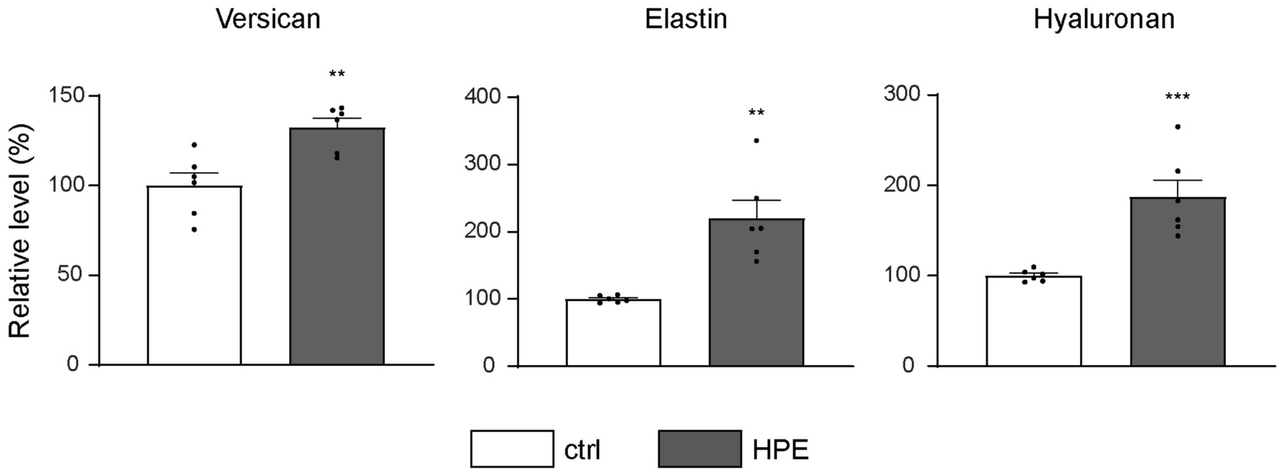
Extracellular-matrix proteins measured in cultured human dermal fibroblasts after treatment with human placental extract. From Chang et al., 2022.
They then looked at the proteins themselves and reported increased levels of type I collagen, versican, elastin and hyaluronan in the treated cells.
That gives us evidence that human placental extract can influence fibroblast behaviour and extracellular-matrix biology. It does not tell us what happens when Laennec or Melsmon is injected into human facial skin.
The distinction is important because the experiment was performed using cultured human cells in a laboratory. There was no treatment of human faces and no measurement of skin thickness, elasticity or collagen six months later.
So we have a biological signal, but not yet a direct answer to the aesthetic question.
Collagen is not a switch
“Stimulates collagen” makes the process sound much simpler than it is.
Collagen production is influenced by fibroblasts, growth factors, inflammatory signals, mechanical forces and the extracellular matrix surrounding the cells. Skin isn't a static material where you simply add collagen and get younger tissue back.
The 2022 study is useful partly because the changes weren't limited to one collagen gene. The researchers observed changes across a broader network of extracellular-matrix-related genes and proteins, including elastin and hyaluronan.
That makes the biology more complicated than simply turning collagen production on.
The surrounding tissue environment matters too, which brings us back to one of the themes running through regenerative medicine: the behaviour of a cell depends partly on the environment in which that cell exists.
That doesn't mean placental extract can reset ageing skin. It means there is a plausible biological reason to investigate whether it can influence some of the processes involved in maintaining the extracellular matrix.
There is also a wound-healing story
Placental extracts have actually been investigated for much longer in wound healing than they have been in aesthetic medicine.
A 2010 South Korean study used human placental extract in a mouse full-thickness skin-wound model. The researchers found that treated wounds decreased in size more quickly during the early healing period, with increases in TGF-β and VEGF at particular time points.
There are also human studies involving topical placental extract and chronic wounds. One clinical trial recruited 100 patients with chronic non-healing wounds and compared topical placental extract with control treatment. After eight weeks, 67.5% of patients in the treatment group showed more than 50% epithelialisation, compared with 23.3% in the control group among those who completed the study.
Wound healing is relevant to the biology of skin repair, but it isn't the same thing as rejuvenating healthy facial skin.
A chronic wound is an injured biological system trying to repair itself. Ageing skin is dealing with a different collection of problems involving extracellular-matrix changes, cellular senescence, altered signalling, pigmentation, vascular changes and cumulative environmental damage.
There may be mechanisms that overlap, but the outcomes aren't interchangeable.
A material that helps an injured wound progress through repair does not automatically become an anti-ageing treatment for healthy skin.
And then there is pigmentation
Placental extracts have also been investigated in relation to melanocytes, the cells responsible for producing melanin.
This part of the story is particularly useful because it shows how much the specific preparation matters.
A 2019 study examined placental extracts and melanin production in normal human melanocytes. The researchers found that different extracts could either increase or decrease melanin synthesis, depending on the preparation, and linked these effects to changes in mitochondrial respiration.
That finding makes it difficult to talk about “placental extract” as though it were a single substance with one predictable biological effect.
The source material may be broadly similar, but the finished preparation can differ according to how it has been processed.
A 2025 study investigated another mechanism involved in melanogenesis and reported inhibition of melanin synthesis through effects on proteins including tyrosinase and TRP-1.
There is a relevant piece of context here: the 2025 study was produced by a researcher from Melsmon Pharmaceutical. That doesn't invalidate the findings, but the affiliation is information I would want to know when assessing the evidence.
So does placenta make skin lighter?
This is where I would be careful with the language.
There is laboratory evidence that placental extracts can influence melanogenesis, and there are cosmetic and aesthetic uses built around the idea of pigmentation reduction.
That still isn't the same as demonstrating that injectable Laennec or Melsmon reliably produces clinically meaningful skin-lightening effects in humans.
Pigmentation itself is also more complicated than simply producing more or less melanin. It can change in response to inflammation, ultraviolet exposure, hormonal factors, melanocyte activity and a range of other processes.
So the useful question isn't really whether placenta “whitens” skin.
It is whether a particular preparation, at a particular concentration and delivered in a particular way, produces a measurable change in a particular biological pathway, and whether that change translates into an outcome that matters to people.
That is a much higher bar.
What about actual human skin?
This is where the evidence becomes thinner.
There are human studies of placental extracts, including research involving menopause, general health and wound healing. There are also laboratory studies involving fibroblasts and melanocytes.
What we have much less of is high-quality clinical research asking a very specific aesthetic question:
What happens to healthy human facial skin after repeated injectable Laennec or Melsmon treatments?
That is the study I would really like to see.
Ideally, it wouldn't rely only on before-and-after photographs or a general assessment of “skin quality”. I would want objective measurements of things such as elasticity, dermal thickness, collagen organisation, pigmentation and barrier function, with a properly controlled comparison group and meaningful follow-up.
That would help bridge the gap between the biological effects seen in the laboratory and the claims made about actual skin.
The laboratory and the clinic are asking different questions
This is probably where a lot of the confusion around placenta in aesthetics comes from.
The laboratory evidence can be quite specific. Researchers can expose fibroblasts to an extract and measure gene expression. They can measure collagen-related proteins. They can expose melanocytes to different preparations and observe changes in melanin production. Animal models can be used to investigate wound healing and inflammatory pathways.
A clinic is dealing with an entire person.
The product may be different. The dose may be different. The route of administration may be different. The skin may be healthy rather than injured, and the outcome being measured may be something as subjective as whether the person thinks their skin looks brighter.
Those are very different experimental situations.
The gap between them doesn't make the laboratory research irrelevant. It simply means we shouldn't skip the steps in between.
This is where the idea of bioremodelling comes in
I've become increasingly interested in the distinction between adding something to tissue and changing the environment in which the tissue behaves.
A traditional skin booster is easy to imagine. You put something into the skin and expect that material itself to produce an effect.
But the fibroblast research raises a slightly different possibility. If a biological preparation changes fibroblast behaviour, and fibroblasts alter their production of collagen, elastin, hyaluronan and other extracellular-matrix components, then the effect isn't simply about adding a substance to the tissue.
It is potentially about influencing the cells that maintain the tissue.
That is much closer to the way I now think about regenerative medicine generally. The question isn't always what can we put into damaged or ageing tissue. It can also be what signals, matrix and environmental conditions might encourage the cells already there to behave differently.
Placental extract is only one possible way of asking that question, and the evidence doesn't establish that it can meaningfully remodel ageing human skin.
But it gives us a biological framework for understanding why researchers keep investigating it.
It also helps explain why placenta isn't the same as stem-cell therapy
This distinction is worth making because the two are often discussed together.
A placental extract such as Laennec or Melsmon is a processed biological mixture. It does not contain a population of viable placental stem cells that are being transplanted into the skin.
That is fundamentally different from a cell-based therapy involving viable mesenchymal stromal cells, including the placental or umbilical-derived MSC therapies being investigated in regenerative medicine.
It is also different from cell-free MSC products such as secretomes or extracellular vesicles.
These approaches may share a biological source or some of the same broad language around signalling and tissue repair, but they are not interchangeable.
The question with placental extract is largely about what molecules remain after processing and what biological effects those molecules may have. With a cellular therapy, there are additional questions about the cells themselves, their behaviour, survival, secretory activity and interaction with the tissue environment.
Putting all of these things under the single word regenerative can make them sound much more similar than they actually are.
So does it actually work?
The most honest answer is that there are several pieces of evidence pointing in the same general direction, but they don't yet form a complete clinical picture.
Human-cell research suggests that placental extract can influence fibroblasts and extracellular-matrix biology. Wound-healing research suggests effects on tissue repair. Melanocyte studies suggest that some placental preparations can influence pigmentation pathways.
There are human clinical studies of placental extracts, but the evidence specifically supporting injectable Laennec or Melsmon as treatments for healthy ageing facial skin is much less developed than the language surrounding these products might suggest.
I therefore wouldn't describe Laennec or Melsmon as proven anti-ageing treatments on the basis of the current evidence.
I would describe them as human placental preparations with plausible biological effects, a long clinical history, and some intriguing laboratory findings that still need to be connected more convincingly to human aesthetic outcomes.
That leaves quite a lot of room for uncertainty.
It also leaves room for better research.
What would convince me?
Probably not another before-and-after photograph.
I'd want a properly designed human study that separated the product from the procedure and measured what actually changed in the skin.
I'd want to know whether dermal thickness changed, whether elasticity improved, whether collagen organisation changed, whether pigmentation was affected, and how long any changes lasted.
I'd want to know whether Laennec and Melsmon produced the same results or different ones, because we already know that they are manufactured differently and are not chemically identical.
And I'd want the study to tell us what was actually used, at what concentration, how it was administered and how the outcome was measured.
Without those details, it becomes very easy for the word placenta to do all of the work.
Where I currently land
I started looking at placenta because I was curious about whether it could actually do anything for skin.
The research hasn't given me a clean yes or no.
Instead, it has given me a series of smaller answers.
Placental extracts can affect human fibroblasts in laboratory experiments. Some preparations can influence extracellular-matrix-related genes and proteins. There is evidence around wound healing, and there are studies investigating pigmentation. There are plausible biological connections involving inflammation, oxidative stress and cellular signalling.
But the final step remains much harder.
We need to know whether those biological changes translate into meaningful changes in healthy human skin.
That is the part I don't think we can answer confidently yet.
And I actually prefer that answer to a much simpler one.
Because once you stop treating “placenta” as a magic ingredient, you can start asking much better questions about the preparation, the biology, the tissue environment and the evidence.
For me, that is where the subject becomes much more interesting to investigate.
C·🌷
Research notes
Human placental extract and skin biology Chang et al., 2022 Human placental extract activates a wide array of gene expressions related to skin functions. Read the full study
Human placental extract and wound healing Hong et al., 2010 The effect of human placenta extract in a wound healing model. Read the study
Placental extract and chronic wounds Shukla et al., 2004 A trial to determine the role of placental extract in the treatment of chronic non-healing wounds. Read the clinical study
Placental extracts and pigmentation Yoshimoto et al., 2019 Placental extracts regulate melanin synthesis in normal human melanocytes with alterations of mitochondrial respiration. Read the study
Placental extract and melanogenesis Moriya, 2025 Placental Extract Inhibits Melanogenesis by Inducing the Proteasome-Dependent Degradation of Tyrosinase and TRP-1. Read the study
Human placental extracts Biological effects of human placental extracts: variations in manufacturing methods and compositions. Read the full review