I Bought a Hyperbaric Chamber. Now I'm Trying to Work Out What It's Actually Doing.
I have a hyperbaric chamber at home.
This was probably always going to end with me becoming slightly obsessed with oxygen.
I've been using it regularly, usually for around 90 minutes at 2 ATA, with 20 minutes of oxygen followed by a 5-minute air break. I generally do this five or six days a week, leaving one or two days off.
I wasn't originally looking for some grand anti-ageing experiment. I was curious about HBOT, I had access to a chamber, and I wanted to see what happened.
I've noticed that I sleep better when I'm using it regularly. Recovery from treatments seems noticeably faster, swelling feels less acute and less painful, and it seems to settle much more quickly.
The change in my skin, though, was what made me actually go looking for the research.
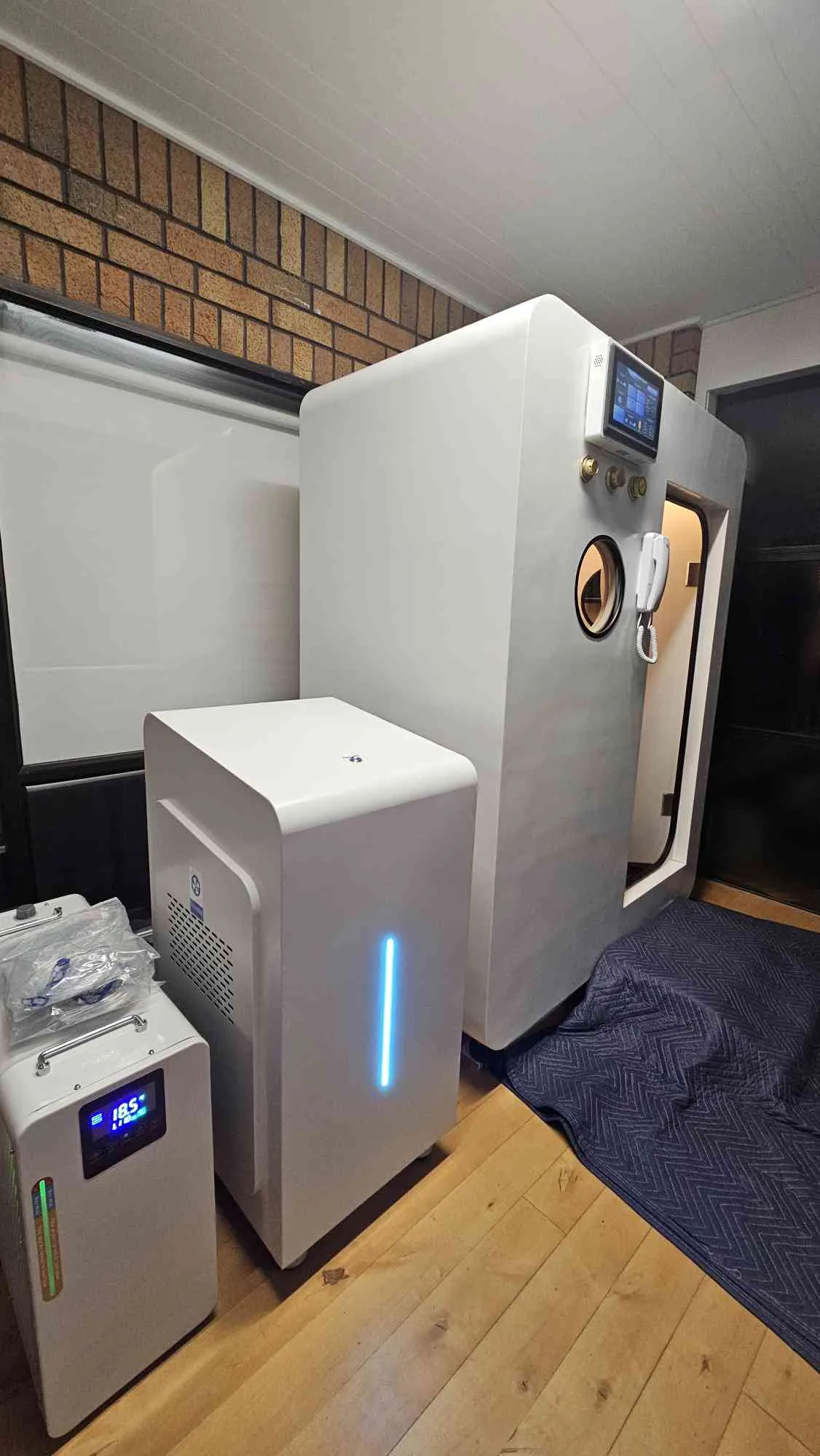
My home hyperbaric chamber. This is what “I'm going to look into oxygen biology” apparently looks like in real life.
So what is all that oxygen actually doing?
At sea level, most of the oxygen carried around the body is attached to haemoglobin. Under hyperbaric conditions, the amount of oxygen dissolved directly in plasma also increases substantially.
But oxygen isn't simply fuel. It is also part of a signalling system, and changing the amount of oxygen available to tissue can influence vascular responses, reactive oxygen and nitrogen species, inflammation, angiogenesis and cellular behaviour involved in repair.
HBOT creates a particularly unusual physiological situation because the exposure is temporary. Oxygen availability rises during the treatment, stays elevated for a defined period, and then returns towards normal when the session ends.
That temporary change may be part of the interesting bit. The body isn't simply sitting in a permanently oxygen-rich environment. It is being exposed to a different environment for a while, and then asked to adjust again when the treatment finishes.
Which is rather more interesting than simply saying “more oxygen”.
The air breaks are part of the experiment
My own sessions are usually structured as 20 minutes of oxygen followed by 5 minutes of air, repeated throughout the treatment.
I originally thought of the air breaks as simply a sensible pause. Then I started reading the protocols used in clinical studies and realised that this pattern wasn't particularly unusual.
A 2024 randomized controlled trial in 63 sedentary adults over 64 used 60 sessions over 12 weeks, with 100% oxygen at 2 ATA for 90 minutes and a 5-minute air break every 20 minutes. The researchers reported an improvement in VO₂max/kg, along with changes in cardiac perfusion and pulmonary measures.
A randomized trial in healthy older adults used a closely related 60-session protocol and reported improvements in global cognitive function, particularly attention and information-processing speed, together with increased cerebral blood flow in several brain regions.
So the pattern I'm using isn't something I invented in my living room.
That doesn't mean my home chamber is equivalent to a controlled clinical trial. The equipment, oxygen delivery, monitoring and medical supervision can all be different. The similarity is in the exposure pattern, not necessarily the entire treatment environment.
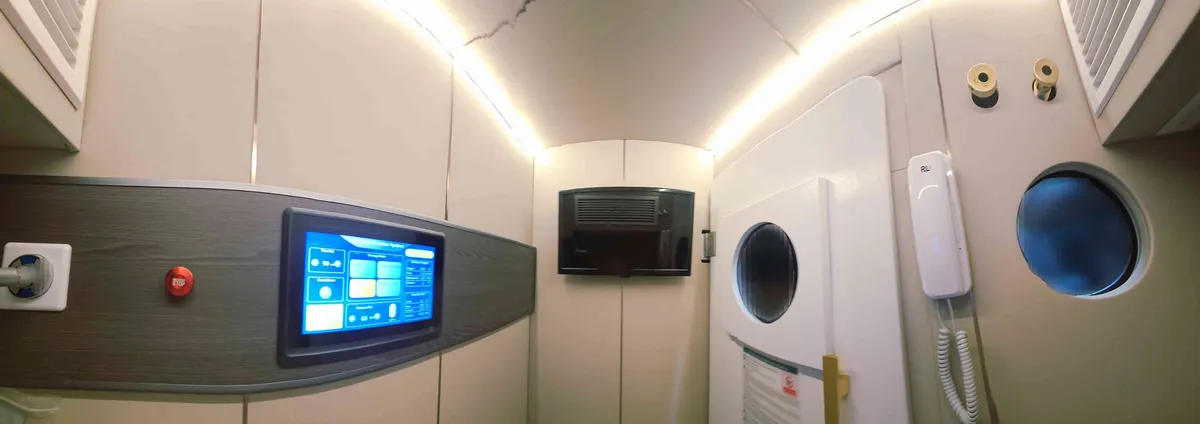
Inside the chamber. The screen is where the rather strange business of pressure, oxygen and air breaks becomes a 90-minute experiment.
Why deliberately expose yourself to more oxygen?
If oxygen is essential for life, it seems intuitive that more oxygen should simply be better. Except biology doesn't really work that way.
HBOT increases oxygen availability and can also increase reactive oxygen and nitrogen species. Those molecules aren't automatically harmful. At controlled levels they can act as signalling molecules, influencing pathways involved in adaptation, vascular responses and repair.
This is one reason researchers have become interested in intermittent hyperoxia. The exposure rises, then stops. The body returns towards normal oxygen conditions, and the cycle happens again.
The idea is that these repeated changes may trigger adaptive responses that aren't produced in quite the same way by constant oxygen exposure.
It's a form of biological stress, although that sounds slightly more alarming than it needs to. The useful question is whether the body can turn that stress into an adaptive response.
The first thing I noticed was sleep
I wasn't originally using HBOT because I had decided oxygen was going to improve my sleep. But I noticed it.
I sleep better when I'm using it regularly. That is obviously a personal observation rather than a clinical trial. I don't have a control group, I'm not measuring my sleep architecture, and I can't separate HBOT from everything else happening in my life.
Still, sleep is one of those things that makes you curious when you notice a change.
There is at least some human evidence worth watching. A 2025 randomized trial involving 80 people with chronic insomnia at high altitude found greater improvements in Pittsburgh Sleep Quality Index and Insomnia Severity Index scores after a 10-day HBOT intervention than in the control group. The study population was young and living at high altitude, so it can't simply be translated to ordinary insomnia at sea level, but it does provide an interesting human signal.
I'm not going to announce that HBOT fixes sleep based on my bedroom observations.
I am, however, interested enough to keep watching.
I've also noticed the inflammation
Sleep was the first thing I noticed, but the change in inflammation has been harder to ignore. The swelling I tend to get around my joints, including across the tops of my feet and around my wrists, has settled considerably when I've been using the chamber regularly. The areas feel less inflamed and uncomfortable, and the swelling seems to resolve much more quickly.
I obviously can't tell from my own experience exactly which part of HBOT is responsible, or whether someone else would experience the same thing. But there is some human research that makes the observation rather interesting.
A 2025 randomized controlled trial in 80 people recovering from total knee replacement found that the HBOT group had lower inflammatory markers, including CRP and IL-6, together with less limb swelling, lower pain and better early range of motion than the control group. A 2026 systematic review of 19 human studies also found evidence of benefit in several musculoskeletal conditions, particularly bone-marrow oedema and avascular necrosis, although results were much less consistent for muscle and soft-tissue injuries.
There are smaller studies in rheumatoid arthritis too, including a pilot study reporting improvements in disease-activity measures and joint pain. The evidence is still far too limited to treat HBOT as an established therapy for inflammatory arthritis, but it does make the biology worth looking at.
My experience obviously isn't proof that HBOT is treating the underlying cause of my swelling. It does, however, make the research into tissue oxygenation, inflammation and oedema considerably more interesting to me.
Then I noticed what happened to my skin
This is where the research became particularly interesting to me.
A 2021 prospective clinical trial looked specifically at normal ageing skin. Researchers recruited older adults and took skin biopsies before and after a three-month HBOT course. The treatment was 2 ATA for 90 minutes, five times a week.
Thirteen men who agreed to repeated biopsies completed the tissue-analysis part of the study.
The researchers found increased collagen density, longer and less fragmented elastic fibres, more blood vessels and fewer senescent cells in the sampled skin after the treatment period.
What caught my attention was that they weren't simply asking whether someone's skin looked better. They were looking underneath it.
The collagen finding is particularly interesting
We spend a lot of time in aesthetics talking about collagen stimulation, elastin, extracellular-matrix remodelling and ways of changing the behaviour of ageing skin. Usually, we approach those things by putting something into the tissue or deliberately creating a controlled injury that encourages the skin to repair itself.
HBOT approaches the tissue from somewhere else. It temporarily changes the environment around it and then lets the body return towards its usual conditions.
The study found a significant increase in collagen density after HBOT, while elastic fibres became longer and less fragmented. The researchers also found more blood vessels and fewer senescent cells in the sampled skin.
There are plenty of ways to turn those findings into a very exciting headline.
I'm trying not to.
The study was small, involving a subgroup of 13 men, and it wasn't a large randomized trial measuring cosmetic outcomes. It also had disclosed conflicts of interest involving several authors and AVIV Scientific.
So I wouldn't describe it as proof that HBOT rejuvenates everyone's skin.
I do find it fascinating that repeated HBOT was associated with measurable changes in actual human skin tissue. Collagen density, elastic fibres, blood vessels and cellular senescence are rather more interesting endpoints than being handed a photograph and told that your skin looks three years younger.
And then there is the recovery thing
This is where my partner and I both started paying attention.
After aesthetic treatments that cause swelling, he particularly likes the feeling of being in the chamber. The compression itself feels good to him, and the swelling seems less intense and settles much faster.
I've noticed something similar. After treatments, the swelling seems less acute and less painful, and recovery feels much quicker.
Again, these are observations. I know perfectly well that two people noticing something isn't a randomized controlled trial.
But the recovery question has actually been studied, which makes the observation rather more interesting.
A 2025 systematic review and meta-analysis looked at 11 studies involving 734 patients undergoing aesthetic surgery. Across the included studies, HBOT was associated with shorter healing times, with protocols ranging from 45 to 120 minutes at pressures of 2.0 to 3.0 ATA. The authors found the results encouraging, while also pointing out the substantial variation between studies and the need for better randomized trials.
There is also a small facelift case-control study involving 20 patients that reported substantially shorter mean wound-healing time in the HBOT group. It's an interesting result, although a study that small can't tell us how broadly the finding applies.
So my experience isn't proof that HBOT makes every aesthetic treatment recover faster.
It does make me rather curious about why the swelling after my own treatments seems to behave differently.
Why might swelling respond?
Pressure adds another layer to the physiology.
HBOT involves both pressure and oxygen. The increased pressure changes gas behaviour and, together with the high oxygen exposure, can alter tissue oxygenation, vascular responses and signalling involved in inflammation and repair.
This is one reason HBOT has long been used in selected situations involving compromised tissue, wounds, grafts and flaps. The clinical rationale isn't simply that oxygen is “good for healing”. It is that unusually high tissue oxygen availability can support biological processes that become difficult when tissue is injured or poorly oxygenated.
The aesthetic literature is newer and much less established, but it is growing.
A 2025 systematic review of HBOT in aesthetic medicine and anti-ageing reviewed the available literature across areas including skin ageing, wound healing and aesthetic applications. The authors concluded that HBOT shows potential, while also emphasising the limitations of the existing evidence.
That seems about right to me.
Potential is not proof. But potential backed by human tissue studies is considerably more interesting than marketing.
Korean aesthetics seems to have noticed this too
One of the things that sent me further down this particular rabbit hole was seeing HBOT used around aesthetic treatments in Korean clinics.
It makes intuitive sense. If you've just deliberately created inflammation in the skin, whether through lasers, injectables, energy-based treatments or other procedures, the recovery period becomes part of the treatment.
If HBOT can influence tissue oxygenation, angiogenesis, inflammatory signalling and repair, it isn't particularly strange that aesthetic practitioners would be interested in using it around procedures.
The evidence still needs to catch up with the enthusiasm, though.
A 2024 evidence-based review of HBOT in aesthetic practice identified human studies involving skin ageing and postoperative recovery, including the study showing changes in collagen density and elastic fibres. The authors were positive about the potential but cautious about the quality and size of the evidence base.
So I wouldn't say that Korean clinics have proved HBOT makes every aesthetic treatment recover faster.
I would say there is enough biology and early clinical evidence for aesthetic medicine to be interested in what happens when you put a healing body somewhere with more oxygen and pressure.
Having spent a fair amount of time inside one myself, I can understand the curiosity.
What about stem cells?
One of the findings that originally made me pay attention to HBOT involved circulating stem and progenitor cells.
In a human study, a single exposure to 2 ATA oxygen for two hours approximately doubled circulating CD34+ cells. After 20 treatments, circulating CD34+ cells had increased eightfold. The researchers proposed a nitric-oxide-dependent mechanism for mobilisation from the bone marrow.
Read the stem-cell mobilisation study
That sounds dramatic, but there is an important distinction between mobilising cells into the bloodstream and demonstrating that those cells then produce a meaningful clinical benefit.
The study showed mobilisation. It did not show that HBOT therefore regenerates whatever tissue you want it to regenerate.
Still, the finding fits neatly into the broader picture. Oxygen availability is changing the environment in which cells behave, and the body is responding to that change in more ways than simply making oxygen available to mitochondria.
The longevity literature gets a little more complicated
A 2020 prospective study gave 35 healthy adults aged 64 and older a course of 60 daily HBOT sessions. The researchers reported increases in telomere length in several blood-cell populations and reductions in some senescent immune-cell populations.
That is intriguing.
It is also exactly the sort of finding that can become “HBOT reverses ageing” within about three seconds of reaching the internet.
The study did not show that.
It measured changes in particular biological markers following a specific HBOT protocol. It did not demonstrate that participants had become younger in every meaningful sense, nor that HBOT extends human lifespan. There were also disclosed conflicts of interest involving AVIV Scientific.
So I'm interested in the finding. I'm just not going to turn it into a miracle claim.
The skin research is more compelling to me precisely because the researchers were able to look at the tissue itself rather than relying entirely on an indirect marker.
There is something very satisfying about the biology of this
The more I read about HBOT, the less convincing the phrase “more oxygen” starts to sound. The interesting part isn't simply that more oxygen reaches the tissue during a session. It's what happens when you temporarily change the oxygen environment around living cells and then return them to normal conditions.
That change can influence a surprisingly wide range of processes. Oxygen availability affects vascular signalling, reactive oxygen and nitrogen species, inflammation and cellular responses involved in repair. Research into HBOT is increasingly looking at how those responses might translate into changes in blood flow, tissue repair, collagen, cellular senescence and even cognition.
Most of the things I find myself researching in aesthetics involve putting something into the tissue or using energy to deliberately create a biological response. With HBOT, the intervention is much more basic: change the physical environment for a while, then take it away and see how the tissue responds.
That leaves a rather nice question. Not simply whether more oxygen is good, but what living tissue actually does when its environment changes.
What about the dose?
My own routine is around 2 ATA, 90 minutes, 20 minutes of oxygen followed by 5 minutes of air, five or six days a week, with one or two days off.
Then I discovered that the skin-ageing study used 2 ATA for 90 minutes, five times a week for three months.
The resemblance is interesting, but it doesn't make the two experiences equivalent. The clinical study had defined equipment, medical-grade oxygen, screening, monitoring and a finite treatment course. My home chamber is a different environment.
The research also doesn't tell us that continuing indefinitely is better, or that this is the correct longevity protocol for a healthy person.
It simply means that the exposure pattern I've ended up using has actually been studied in humans.
I found that rather satisfying.
More isn't automatically better
This is the part where my enthusiasm needs a little supervision.
Oxygen is essential, but sufficiently high oxygen exposure can also produce toxicity, while pressure introduces its own problems, particularly for the ears and other air-filled spaces.
A 2023 systematic review and meta-analysis covering 24 randomized trials and 1,497 participants found adverse effects were more common in HBOT groups than controls. Ear discomfort was the most frequently reported side effect, and the review found higher adverse-event rates with treatment courses longer than 10 sessions and pressures above 2 ATA.
That doesn't make HBOT dangerous. It makes it a dose-dependent physiological intervention, which is a rather more useful way of thinking about it.
It's also why I'm increasingly suspicious of anyone presenting one HBOT protocol as the protocol for everyone.
My chamber is also not a medical trial
This is worth saying because I am literally doing this at home.
Clinical HBOT is a medical procedure with specific equipment, oxygen delivery, screening, monitoring and safety standards. The Undersea and Hyperbaric Medical Society defines clinical HBOT around a hard-sided chamber, physician-prescribed medical-grade oxygen and appropriate pressure and oversight.
A home chamber is a different environment. Even if the numbers on the screen look familiar, that doesn't make the experience identical to a published clinical trial.
So when I talk about my own HBOT routine, I'm talking about my experience with a technology, not suggesting that someone should copy it.
That distinction becomes particularly important when the research itself hasn't established a universal protocol for healthy people using HBOT for longevity.
So, am I going to keep using it?
Obviously.
My sleep is better. My recovery seems faster. The swelling I get after treatments feels less acute, less painful and much quicker to settle.
And honestly, my skin is the bit that has really sold me on continuing to investigate it.
I can see and feel a difference in my skin after regular HBOT. It looks better to me, feels better, and occasionally I catch myself in the mirror and have that slightly embarrassing little moment of thinking, oh.
That is still my experience. It isn't a clinical endpoint.
But now there is a rather good scientific question sitting underneath it.
When researchers looked inside ageing human skin after a defined HBOT course, they found changes in collagen, elastic fibres, blood vessels and senescent cells.
I wasn't expecting that.
I started this because I had a chamber and was curious.
Now I have a chamber, considerably more questions, and a rather large folder of papers about oxygen biology.
C·🌷
Research notes
HBOT and skin ageing
Hachmo et al., 2021
The effect of hyperbaric oxygen therapy on the pathophysiology of skin aging: a prospective clinical trial.
HBOT in aesthetic medicine and anti-ageing
Fisher et al., 2025
Hyperbaric Oxygen Therapy in Aesthetic Medicine and Anti-Aging: A Systematic Review.
HBOT after aesthetic surgery
Mortada et al., 2025
Efficacy of Hyperbaric Oxygen Therapy as an Adjunct in Aesthetic Surgery: A Systematic Review and Meta-analysis of Postoperative Outcomes and Complications.
HBOT and sleep
2025
Hyperbaric oxygen treatment for chronic insomnia at high altitude: A prospective, randomized, open-label, parallel-group trial.
Stem-cell mobilisation
Thom et al., 2006
Stem cell mobilization by hyperbaric oxygen.
Cognitive function in healthy older adults
Hadanny et al., 2020
Cognitive enhancement of healthy older adults using hyperbaric oxygen: a randomized controlled trial.
Physical performance in older adults
Hadanny et al., 2024
Physical enhancement of older adults using hyperbaric oxygen: a randomized controlled trial.
Telomeres and cellular senescence
Hachmo et al., 2020
Hyperbaric oxygen therapy increases telomere length and decreases immunosenescence in isolated blood cells: a prospective trial.
HBOT safety
Zhang et al., 2023
Adverse effects of hyperbaric oxygen therapy: a systematic review and meta-analysis.
Doctor / podcast
Dr Shai Efrati
How Hyperbaric Oxygen Therapy Improves Cognition.
Clinical HBOT
Undersea and Hyperbaric Medical Society
HBO₂ Indications and Safe Delivery.