I Started With PDRN Injections. Now I Carry the Eye Drops Everywhere
I originally started using PDRN for my joints.
I had been reading about its research around tissue repair and inflammation and wondered whether it might help with some longstanding musculoskeletal problems of my own. I decided to do a 20-day experiment with Revitalex PDRN, using it intramuscularly.
I am keeping the details of my medical history private, but the general reason was simple enough: I wanted to see whether improving the surrounding tissue environment might make any difference to how I felt and moved.
The first few days were fairly ordinary. The injections were a little pinchy because of the volume, so I found a small amount of lidocaine made them more comfortable. Somewhere around days six to ten, though, I started noticing a difference. There seemed to be less of the grinding sensation I had become used to, and by around the second week the change felt much more obvious.
I wasn't expecting PDRN to rebuild a joint. I was interested in inflammation, soft tissue and function, so I was paying attention to things like pain and how the hip felt during normal movement. The first round was genuinely impressive to me. I repeated it later, although the second round didn't feel quite as dramatic as the first.
That experience is also why I am careful about how I talk about it. The human osteoarthritis research I found is mainly on intra-articular PDRN, particularly for knee OA, rather than the intramuscular approach I used. A 2019 systematic review and meta-analysis of five randomized controlled trials found that intra-articular PDRN gave better short-term pain improvement than hyaluronic acid at one and two months, although there was no significant difference in function and the benefit was not maintained at four months. (Kim et al., 2019)
So my experience is exactly that: my experience. It made me curious enough to keep looking at PDRN, rather than proving that the same thing will happen to someone else.
My husband eventually tried it too. He has his own longstanding knee problem following an old injury and surgery, so I am keeping that history vague as well. His response was much more striking than I expected. After his course, he was doing things that had been difficult for him for years, including jogging, running and gym workouts.
He only needed one course before moving to intermittent upkeep, and that was enough to make PDRN a permanent part of our personal toolkit.
Then I noticed something I hadn't really been looking for.
The skin effects were a surprise
Over time, I became very happy with the way my skin felt and looked. It seemed more resilient and, to me, had a better dermal quality and barrier.
My husband's skin changed too. He had always been prone to sensitivity and flaking, particularly after shaving, and that became much less of an issue.
That was unexpected because my original interest in PDRN had been about damaged tissue and inflammation. Once I started paying attention to the skin side, though, the research became even more interesting.
A 2020 systematic review of PDRN research covering laboratory, animal and clinical studies found evidence supporting roles in tissue repair and healing, with proposed involvement of adenosine A2A receptor signalling and nucleotide salvage pathways. (Colangelo et al., 2020)
The evidence still isn't neat. Different preparations, routes and clinical situations are being studied, so I don't think it makes sense to treat every PDRN product as though it is interchangeable.
That brings me to the little things I now carry around.
My Korean PDRN eye-drop stash
I use Korean PDRN eye drops including Re-An and Ocusis Recovery.
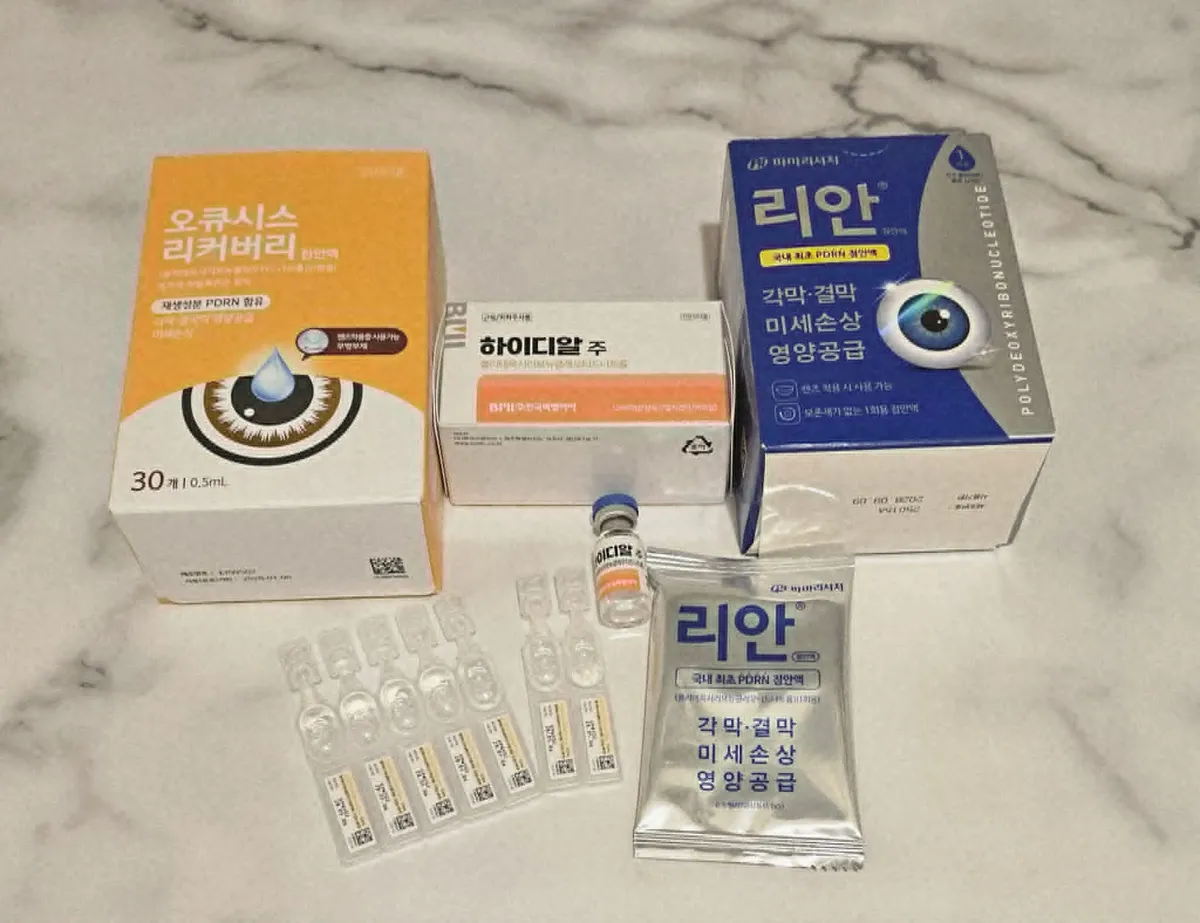 my PDRN stash: Re-An, Ocusis Recovery, & my injectable PDRN.
Both contain polydeoxyribonucleotide sodium at 0.75 mg/mL. Re-An is an ophthalmic PDRN preparation supplied in small single-use containers, with Korean product information listing indications relating to corneal and conjunctival damage. Ocusis Recovery is also a single-use ophthalmic preparation containing 0.75 mg/mL PDRN sodium; the product information lists corneal and conjunctival microdamage among its indications. Ocusis Recovery also contains sodium hyaluronate, which gives it a slightly different feel from Re-An. (Re-An product information; Ocusis Recovery information)
This is where I became a little obsessed with the format.
The vials are tiny. They're sterile ophthalmic preparations, they are easy to carry, and each one is single use. For travel, that is far more appealing to me than carrying around a large bottle that has been opened and closed a hundred times.
And I don't only use them for my eyes.
The plane is one of my favourite places to use them
Long flights leave my skin feeling dry and tired, so I sometimes use the drops topically as a very simple hydration step.
It is one of those travel things that started almost by accident. I had PDRN eye drops with me anyway, realised how convenient the little sterile vials were, and started using the remainder on dry facial skin.
I also use them as a very basic emergency toner or mist when my skin feels dehydrated. Sometimes I think they make my skin look fresher afterwards, although that part is simply something I've noticed rather than a clinical claim.
The eye itself has a much stronger evidence base.
A randomized, double-blind, placebo-controlled trial looked at PDRN eye drops after photorefractive keratectomy. By day three, complete corneal re-epithelialisation had occurred in 77% of eyes receiving PDRN compared with 61% of eyes receiving placebo, although by day seven all eyes in both groups had healed. The study was small and the authors called for larger trials, but it is still an actual human trial of PDRN eye drops in epithelial healing. (Lazzarotto et al., 2004)
That is a much more interesting reason for me to keep them around than simply seeing PDRN printed on a label.
Somehow they ended up in my car
I now have PDRN eye drops in my travel kit and in the car.
My emergency bag already contains the usual things: gauze, bandages, wound spray and a pair of unnecessarily serious scissors. PDRN joined the collection because the little vials are so easy to carry.
I use them for the sort of minor situations where I want something small and convenient around while the skin settles down. Dry, irritated skin. A scrape. Minor superficial damage. Travel dehydration.
I have even used them as a quick facial mist when I've had nothing else with me.
I wouldn't call an ophthalmic PDRN product a wound cleaner, because that is not what it is licensed for. I just happen to like having a sterile, single-use liquid available when I need something gentle and convenient.
There is a difference between saying "this is what I use" and saying "this is what this medicine is indicated to treat."
I try to keep those separate.
My friend's waxing disaster
One of my friends had a particularly enthusiastic moustache waxing experience.
The skin was badly irritated and visibly pink during the healing process. She had already started using Bepanthenol-D and was happy with it, but when I mentioned PDRN eye drops she initially thought I meant she was going to need a PDRN injection.
I had to explain that I meant the little eye drops.
She started using them topically after the skin had recovered enough that touching it was comfortable. She found the healing surprisingly quick, especially during the sloughing phase, and was very happy with the result.
Another friend later tried the same thing and had a similar impression of faster recovery.
One friend had a much more serious kitchen mishap and burned her arm badly on the oven. She didn't have the PDRN eye drops, so in her case she was using injectable PDRN alongside my other usual go-to, Laennec. She felt that the pain settled more quickly and that the recovery seemed faster than she expected.
It's obviously impossible to draw any conclusions from one person's experience, but it was another interesting little data point in my growing collection of "oooh, that's worth watching."
I find these experiences interesting, but I don't treat them as evidence. They are three (5 including me and husband) people's observations of minor burns and irritated skin, not controlled studies.
What makes them worth mentioning is that there is a research story around tissue repair that makes the observation at least plausible.
The PDRN literature includes wound-healing studies as well as ophthalmic studies. The 2020 systematic review I mentioned found promising results across different models of tissue repair, although the authors were working with a very mixed evidence base. (Colangelo et al., 2020)
There is also a growing dermatology literature looking at PDRN and polynucleotides for wound healing and skin rejuvenation. A recent systematic review of randomized clinical trials found the most consistent benefits in wound-healing settings, particularly re-epithelialisation and healing time, while also pointing out the limitations of the current evidence. (2026 systematic review)
And then there is Panthenol-D
The other half of my friend's burn routine was Panthenol-D.
That makes sense to me because PDRN and panthenol are doing very different things.
Panthenol is much less exotic, but there is good human evidence behind its role in skin hydration and barrier function. A randomized, double-blind, placebo-controlled study found that topical dexpanthenol improved stratum corneum hydration and reduced transepidermal water loss after seven days. (Gehring & Gloor, 2000)
Another randomized study found that a dexpanthenol-containing cream accelerated barrier repair after experimentally induced irritation and also improved hydration and redness. (Dexpanthenol and barrier repair)
That is why I like the combination so much.
The PDRN is the part that interests me for tissue repair. The panthenol is there to keep the recovering skin hydrated and support the barrier while it gets itself back together.
For my friend's burn, the Panthenol-D was what kept the area comfortable and moisturised while it healed, and the PDRN was the unexpected extra she became very enthusiastic about.
My little emergency arsenal
This has all become slightly funny because I started with a fairly specific medical interest and somehow ended up carrying PDRN eye drops around like other people carry lip balm.
There is some in my travel kit. There is some at home, my purse, my car emergency kit. They sit beside the sterile gauze, bandages and medical grade scissors.
And, naturally, this is all perfectly normal in the same household that has an emotional-support Laennec stash.
I like the eye drops because they are small, single use and easy to throw into a tiny purse. Their actual medical purpose is ophthalmic, but I have found them surprisingly useful as a personal travel and emergency skincare item, too.
The research is still evolving, and I am much more interested in that than in pretending a little vial of PDRN is magic. What started as one very specific experiment ended up giving me another thing I actually reach for.
As for now, I never travel without it.
A little thank you to my friends who unwittingly inspired this post through our chats, questions and random "wait, you can actually use it for this?!" conversations. 💗 You know who you are. Thank you for letting me be your resident "let's try this because Ces tried it" nerd. At this point, I think we're all just unofficial lab mice. 😂🧪
C·🌷
Research notes
- Kim et al., 2019. The efficacy and safety of polydeoxyribonucleotide for knee osteoarthritis
- Lazzarotto et al., 2004. PDRN eye drops and corneal epithelialisation after PRK
- Colangelo et al., 2020. The effects of PDRN on wound healing and tissue regeneration
- Gehring & Gloor, 2000. Dexpanthenol and epidermal barrier function
- Dexpanthenol and skin-barrier repair
- 2026 systematic review of PN/PDRN clinical trials
- Re-An Korean product information
- Ocusis Recovery Korean pharmaceutical information