Laennec and the Liver
The medical life Laennec had long before anyone started calling it a beauty treatment
Laennec is probably best known outside Japan for something it was never originally developed to be.
An aesthetic injectable.
But in Japan, Laennec has a much more specific medical identity. It is a prescription medicine indicated for improvement of hepatic function in chronic liver disease, with a standard 2 mL ampoule containing 112 mg of water-soluble human placental extract.
Read the official Laennec information
That makes the liver a rather important part of the Laennec story.
Before we get into skin, collagen, recovery or all the other things placenta has become associated with, it is worth going back to the question Laennec was actually developed around:
What can a placental extract do to a damaged liver?
Why the liver?
The liver is one of the body's great repair organs. It is constantly processing nutrients, drugs and other compounds while maintaining metabolism, producing proteins and carrying out an enormous number of biochemical processes.
It is also remarkably capable of regeneration.
But chronic liver disease changes the picture. Persistent injury and inflammation can progressively alter liver tissue and, in some conditions, lead to fibrosis and cirrhosis.
This makes the liver an interesting target for a preparation that has been investigated for effects involving inflammation, oxidative stress and tissue repair.
Japan Bio Products describes Laennec as a human placental hydrolysate containing a complex mixture of biologically active substances. The manufacturer also discusses hepatocyte growth factor, or HGF, as one of the growth-related factors associated with liver-cell proliferation and repair.
But the manufacturer makes an important point too: the primary pharmacological action of Laennec cannot be attributed to a single substance or group of substances.
Read the manufacturer's pharmacology information
That fits with what we saw in the previous post.
Laennec isn't one molecule.
It is a complex biological mixture.
Laennec's original clinical story
The liver story goes back decades.
Japan Bio Products lists a double-blind crossover study involving 124 patients with chronic hepatitis or liver cirrhosis, in which serum GOT and GPT, the older names for AST and ALT, improved significantly with Laennec.
The original study was published in 1974, long before placental injections became part of the modern aesthetics conversation.
Read the clinical information from Japan Bio Products
A reduction in liver enzymes is useful information because these markers can reflect liver injury. But it is not the same thing as demonstrating that a treatment reverses fibrosis, prevents cirrhosis or improves long-term outcomes.
Those are much harder questions.
What about fatty liver?
This is where some of the more recent research becomes interesting.
A small pilot study looked at 10 people with biopsy-proven non-alcoholic steatohepatitis, or NASH, who had not responded adequately to lifestyle intervention. They received Laennec injections twice a week for 24 weeks.
Nine people who continued treatment showed significantly lower serum transaminase levels after eight weeks. Seven participants underwent a second liver biopsy, and their average NAFLD Activity Score decreased from 5.29 to 4.00, although this change did not reach statistical significance.
That is a useful example of why the actual evidence is more interesting than the claims built around it.
The liver enzymes improved, but the study was tiny and the changes seen on liver biopsy were much less conclusive.
It gives us a biological signal.
It doesn't establish Laennec as a treatment for fatty liver disease.
A larger comparative study
A larger multicentre study looked at human placental extract in people with alcoholic or non-alcoholic steatohepatitis.
The study included 194 participants in the intention-to-treat analysis and compared human placental extract with a commercially available liver extract and flavin adenine dinucleotide preparation.
The primary endpoint was defined as a 20% or greater improvement in ALT from baseline. In the per-protocol analysis, this was achieved by 62.9% of participants in the placental-extract group and 48.8% in the comparator group.
The difference was not statistically significant, with p = 0.0772.
The researchers concluded that the clinical value of human placental extract was equivalent, or non-inferior, to the comparator treatment.
So again, the sensible conclusion isn't that Laennec was proven superior.
It is that a reasonably sized clinical study found improvements in liver-function markers in people receiving placental extract, while the primary comparison between treatments did not reach statistical significance.
What does “improving liver function” actually mean?
This phrase can sound much more dramatic than it is.
Laennec's Japanese indication is the improvement of hepatic function in chronic liver disease. In the clinical research, this has largely been assessed using measures such as ALT, AST and other liver-function markers.
That doesn't mean detoxing the liver, reversing cirrhosis or restoring a damaged liver to its original state.
It also doesn't mean that someone without liver disease needs placenta injections to keep their liver healthy.
The distinction matters because the medical indication is specific, while the wellness language that has grown around placenta is much broader.
But there is still a biological question
Why might a placental extract affect liver-function markers in the first place?
Researchers have proposed several possibilities, including effects involving oxidative stress, inflammation and growth-related signalling. The placenta contains a complicated mixture of peptides, amino acids and other biological compounds, and Laennec's manufacturing process produces a hydrolysed extract rather than a single active molecule.
HGF is one molecule that has attracted attention because it is involved in hepatocyte proliferation and tissue repair.
But it would be far too simple to reduce the mechanism to:
placenta → HGF → liver regeneration
The finished preparation contains many different components, and we still don't know which are responsible for particular effects.
That uncertainty is one of the recurring themes in the Laennec story.
So why did it become an aesthetic treatment?
This is where the history takes an unexpected turn.
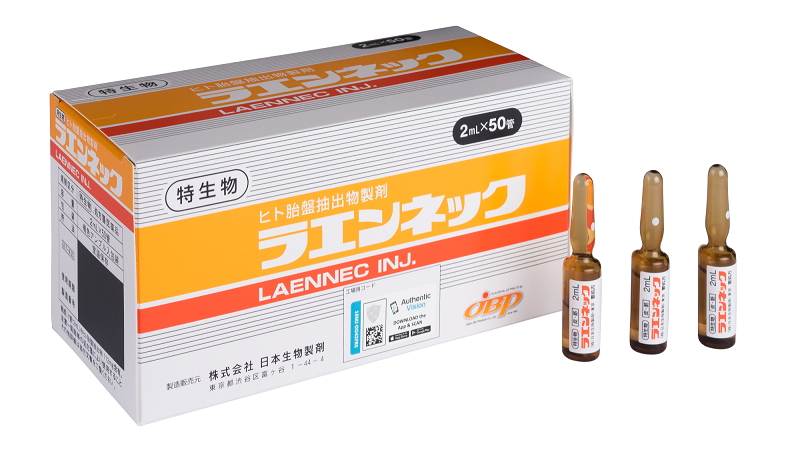
Laennec injection, Japan Bio Products.
Laennec was developed as a pharmaceutical preparation for liver disease, not as a cosmetic injectable. But once a biological preparation has a long history involving inflammation, oxidative stress, tissue repair and cellular signalling, it isn't difficult to see why aesthetic medicine became interested.
The language changes depending on the setting.
In liver medicine, the conversation is about hepatic function.
In aesthetics, it becomes repair, recovery, regeneration and rejuvenation.
Those words can describe related biological processes, but they don't mean the same thing clinically. Evidence that a treatment changes liver enzymes doesn't tell us that it improves skin, stimulates facial collagen or makes someone look younger.
Those are separate questions.
And that is what makes Laennec interesting
Laennec has a much longer medical history than its current reputation as a beauty injectable suggests. It is a human-derived pharmaceutical preparation with a specific indication, decades of clinical use and a body of research that extends from liver disease into questions about inflammation, oxidative stress and tissue biology.
The evidence isn't as simple as “Laennec regenerates the liver.” Some studies show improvements in biochemical markers; others are small or inconclusive, and we still don't have a complete explanation for which components are responsible for the effects.
But that makes the story more interesting to me.
Because before Laennec became something people talked about for skin, it was being studied for something much more concrete:
what can a complicated biological extract actually do to damaged human tissue?
That question is still being worked out.
And perhaps that is the part of Laennec's history worth remembering when we see it sitting in an aesthetic clinic.
C·🌷
Research notes
Laennec
Japan Bio Products
Official product information, composition, indication, safety information and clinical data.
Read the manufacturer information
Laennec and chronic liver disease
Double-blind comparative study for chronic hepatitis and liver cirrhosis.
Read the clinical information
Human placental extract and NASH
Shimokobe et al., 2015
Human placental extract treatment for non-alcoholic steatohepatitis non-responsive to lifestyle intervention: A pilot study.
Read the study
Human placental extract for alcoholic and nonalcoholic steatohepatitis
Choi et al., 2014
Efficacy and Safety of Human Placental Extract for Alcoholic and Nonalcoholic Steatohepatitis: An Open-Label, Randomized, Comparative Study.
Read the full study
Placental extract and NASH
Placental extract ameliorates non-alcoholic steatohepatitis by exerting protective effects on endothelial cells.
Read the full study
Human placental extract and health status
Effect of Human Placental Extract on Health Status in Elderly Koreans.
Read the full study