Laennec vs Melsmon
Same placenta, very different stories
There is a point in every placenta journey where you stop saying “placenta injections” and start having opinions about brands.
Laennec people. Melsmon people. People who insist one is better for skin, while the other is better for women’s health. And then there are people like me, quietly maintaining an emotional support supply of both.
But Laennec and Melsmon aren't simply two names for the same thing.
They are both human placental preparations, but they were developed for different medical purposes, are manufactured differently, and have accumulated rather different bodies of evidence.
So I wanted to put them next to each other.
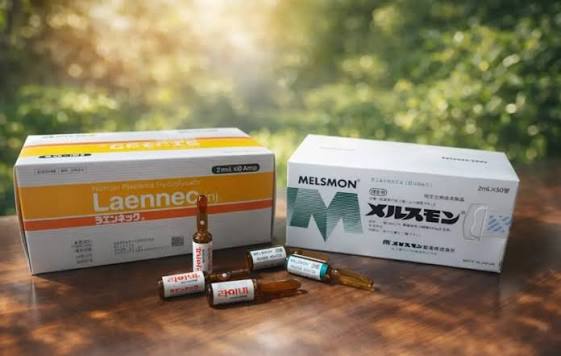
First: they are both human placenta medicines
The word “placenta” makes these products sound rather mysterious, but the basic idea is surprisingly straightforward.
Both Laennec and Melsmon are pharmaceutical preparations derived from human placenta. They aren't whole placenta, and they aren't simply liquid placenta. The tissue is processed, hydrolysed and purified into a water-soluble preparation containing a mixture of smaller biological components.
And this is where the first important difference appears.
The final composition depends partly on how the placenta is processed. A recent review comparing human placental extracts describes substantial differences in manufacturing methods and composition, including differences between Laennec and Melsmon.
So what is actually left in the finished extract? What Is Actually Inside Placenta Extract?
So even before we start asking what they supposedly do, it is worth remembering:
same source does not mean same product.
Laennec
Laennec is manufactured by Japan Bio Products and, in Japan, its approved indication is the improvement of hepatic function in chronic liver disease.
Each 2 mL ampoule contains 112 mg of water-soluble human placental hydrolysate. The manufacturer describes the preparation as containing a range of biologically active substances derived from human placenta rather than identifying one single active molecule responsible for its effects.
Read the official Laennec product information
This is one of the things I find most interesting about Laennec.
It isn't really a conventional single-ingredient drug where we can point to one molecule and say, this is the active ingredient. The biological story belongs to a complex mixture, and the manufacturer notes that its pharmacological action cannot be attributed to one particular substance or group of substances.
With Laennec, the biology is messier.
And perhaps more interesting.
Melsmon
Melsmon also comes from human placenta, but its Japanese medical identity is quite different.
It is approved for menopausal disorders and insufficient milk secretion. The Japanese prescribing information describes each 2 mL ampoule as containing 100 mg of water-soluble human placental villous tissue hydrolysate, together with 0.03 mL of benzyl alcohol.
Unlike Laennec, Melsmon is specified for subcutaneous injection in its Japanese prescribing information.
Read the current Melsmon medical information
Melsmon's history also extends well beyond menopause. A 1981 placebo-controlled trial conducted across eight Japanese hospitals included 135 women with insufficient milk secretion. The study reported higher average milk production in the Melsmon group than the placebo group by day seven, although it should be read as a historical clinical trial rather than modern evidence of efficacy.
Read the original Melsmon clinical trial
So already we have something useful:
Laennec: 112 mg
Melsmon: 100 mg + benzyl alcohol
Both are human placental preparations, but they are not identical formulations.
Even the manufacturing process is different
This is the part I wish aesthetic conversations talked about more.
The 2025 review describes Melsmon as being made from screened frozen human term placenta. The villous tissue is processed to remove blood, followed by extraction and purification using hydrochloric acid hydrolysis. The pH is adjusted and benzyl alcohol is added before the final product is sterilised.
Laennec follows a different process. The placenta is refrigerated, washed and dissected, then homogenised, defatted and dried. The resulting material is hydrolysed using pepsin and hydrochloric acid before further processing.
Read the comparison of manufacturing methods
That means the final products aren't simply different labels stuck onto the same bottle of placenta.
The manufacturing process helps determine what is actually in the final preparation.
And that matters when we start talking about biology.
So which one is better?
This is where the internet wants a very simple answer.
Laennec for skin. Melsmon for women. Laennec for recovery. Melsmon for whitening. One is “stronger”. One is “better”. One is for “regeneration”.
I don't think the research allows us to be that confident.
A better question is:
Better for what?
Their medical histories point in different directions. Laennec's established medical identity is closely associated with liver function, while Melsmon's is associated with menopause and insufficient lactation. The aesthetic uses people talk about online are a different category altogether.
Laennec has a surprisingly large research trail
Laennec isn't just an aesthetic product that happens to have some laboratory papers attached to it. It has a much longer history of investigation in liver disease.
The manufacturer describes a double-blind comparative study involving 124 patients with chronic hepatitis or liver cirrhosis, in which serum GOT and GPT improved significantly with Laennec compared with placebo in the reported analysis.
Read the Laennec clinical information
There is also research outside Japan. A Korean study investigated human placental extract in 39 healthy adults aged 65 and over, with participants receiving subcutaneous injections for eight weeks. The study reported improvements in some measures of physical function and general health perception compared with placebo, although the study was small and the authors themselves noted that evidence for human placental extract remained limited.
Read the Korean human placental extract study
There have also been smaller studies investigating Laennec in conditions such as non-alcoholic steatohepatitis.
None of this makes Laennec an anti-ageing drug.
It does make its history considerably more substantial than its current reputation as an aesthetic injectable might suggest.
Melsmon has a different human evidence base
Melsmon's clinical history is particularly interesting because some of its evidence is directly related to women's health.
A Japanese clinical study investigated Melsmon in menopausal disorder and reported an efficacy rate of 77.4% in 31 patients in a later domestic Phase IV study. The manufacturer also reports that an earlier placebo comparison found a significant difference in usefulness between Melsmon and placebo.
Read the Melsmon clinical research
There is also the rather unexpected study we looked at in the first article: Melsmon was investigated for insufficient milk secretion in postpartum women.
The original 1981 study involved 135 cases and compared Melsmon with saline placebo.
Read the original Melsmon milk-secretion study
By day seven, the study reported higher mean daily milk secretion in the Melsmon group than in the placebo group.
It is fascinating evidence, but it is also 1981 evidence. That means it is best read as part of the historical clinical record rather than treated as though it carries the same methodological weight as a large contemporary clinical trial.
And what about menopause?
This is probably the most interesting area for Melsmon because there is now enough research to step back and look at the evidence as a whole.
A 2025 systematic review examined randomized controlled trials of placental extracts for menopausal symptoms. It included both human and porcine placental preparations and found improvements in several measures of menopausal symptoms across the included studies, including vasomotor symptoms such as hot flashes.
One of the included studies compared Melsmon with another human placental extract, Unicenta, and reported improvements in menopausal symptom scores in both groups.
But the review also shows just how heterogeneous this literature is.
Different products. Different doses. Different schedules. Different study designs. Different outcome measures.
Read the systematic review on placental extract and menopausal symptoms
So even here, the sensible conclusion isn't:
Placenta cures menopause.
It is:
There is a clinical research history worth taking seriously, but the evidence is still heterogeneous.
What about skin?
Now we arrive at the part that probably interests most people reading an aesthetics journal.
And this is where things become rather more complicated.
Human placental extract has produced interesting findings in laboratory models of skin biology. A 2022 Scientific Reports study exposed cultured human dermal fibroblasts to human placental extract and found changes in genes associated with extracellular-matrix organisation.
The researchers reported increased expression of genes including COL1A1, ELN and HAS2, alongside increases in type I collagen, elastin, versican and hyaluronan in the experimental system.
Read the 2022 fibroblast study
That is genuinely interesting.
But it still doesn't answer the question:
Does injecting Laennec or Melsmon into human facial skin produce a clinically meaningful anti-ageing effect?
That is a much harder question.
And the answer requires human aesthetic trials, not just fibroblasts.
This is where “regeneration” gets slippery
Placenta products are often described using words such as regeneration, repair, anti-ageing, collagen, whitening and rejuvenation.
Some of these concepts have biological research behind them.
But they don't all mean the same thing.
A cell culture experiment can show that a preparation influences fibroblast behaviour. An animal experiment can show changes in tissue. A clinical study can show improvement in a symptom score. Aesthetic improvement is another question again.
None of those automatically proves that a person will look younger after receiving a particular product.
This is why I think the most interesting thing about Laennec and Melsmon isn't actually the promise of “rejuvenation”.
It is the distance between the biology and the marketing.
There is another difference I find important
Laennec's manufacturer explicitly warns that, because the product is derived from human placenta, the possibility of transmission of infectious agents from the raw material cannot be completely eliminated, despite the safety measures used during manufacture.
Laennec is classified as a specific biological product in Japan, and records of its use are required to be retained for at least 20 years.
Melsmon is similarly classified as a specific biological-derived product, with Japanese requirements around patient explanation, traceability and record keeping.
Read the Laennec safety information
Read the Melsmon safety and prescribing information
That is an important reminder that these are not ordinary cosmetic ampoules.
They are human-derived pharmaceutical products.
Whatever someone thinks of their aesthetic uses, that distinction matters.
So which one would I choose?
This is where I am going to disappoint anyone looking for a definitive ranking.
I don't think the evidence supports saying:
Laennec wins.
Or:
Melsmon wins.
They have different formulations, different approved medical indications and different clinical histories.
And even the word “placenta” hides a remarkable amount of chemistry.
If the manufacturing process changes the resulting mixture, then two products made from the same biological source don't necessarily have identical biological behaviour.
That is probably the most important thing I took away from looking at them side by side.
Same placenta. Different story.
Laennec and Melsmon are close enough to be discussed together, but different enough that treating them as interchangeable doesn't make much scientific sense.
Laennec has a long association with liver medicine.
Melsmon has a long association with women's health.
Both have attracted interest in skin, recovery and aesthetic medicine. Both come from human placenta. Both contain complex mixtures rather than one neat active molecule.
And both have something that modern aesthetics sometimes forgets:
a medical history that existed long before the beauty industry discovered them.
Which brings me back to my boxes.
I still don't know whether my emotional support Laennec stash is scientifically justified.
But I do now know that “placenta injection” is an extraordinarily inadequate description of what is actually going on.
And perhaps that's the more interesting story.
Next: What Is Actually Inside Placenta Extract?
C·🌷
Research notes
Laennec
Japan Bio Products
Official product information, composition, indication, safety information and clinical data.
Read the manufacturer information
Melsmon
Melsmon Pharmaceutical Co., Ltd.
Official medical information, composition, indications, clinical results and safety information.
Read the manufacturer information
Human placental extracts
Biological effects of human placental extracts: variations in manufacturing methods and compositions.
Read the full review
Human placental extract and skin biology
Chang et al., 2022
Human placental extract activates a wide array of gene expressions related to skin functions.
Read the full study
Human placental extract and health status
Kong & Park, 2012
Effect of Human Placental Extract on Health Status in Elderly Koreans.
Read the full study
Placental extract and menopause
Papp et al., 2025
Efficacy and Safety of Placental Extract on Menopausal Symptoms: A Systematic Review.
Read the systematic review
Melsmon and insufficient milk secretion
Karasawa et al., 1981
Melsmon clinical trial on insufficient milk secretion.
Read the original clinical study