What Might Placenta Do Biologically?
Why “recovery” might be a more interesting question than “rejuvenation”
One of the words that keeps appearing around placenta injections is recovery.
People talk about using them after procedures, during periods of stress, when they feel run down, or simply when they want to feel a little more resilient. But what would a biological explanation for that actually look like?
To answer that, we have to move away from the idea of placenta as a beauty treatment and look at something much more fundamental:
inflammation.
Inflammation isn't always the enemy
Inflammation is part of normal repair. When tissue is injured, the immune system responds, damaged material is cleared away and a series of signals coordinate the transition from inflammation into proliferation and tissue remodelling.
The problem is what happens when that process doesn't resolve properly. Persistent inflammation can interfere with tissue repair, increase oxidative stress and contribute to chronic damage.
That is why anti-inflammatory effects come up so often in discussions of recovery. But “anti-inflammatory” needs a little caution too. The goal isn't simply to turn inflammation off; the body needs an inflammatory response to repair itself.
The more useful question is whether a treatment can influence when, where and how strongly that response occurs.
What does placenta have to do with this?
Placental extracts have been investigated for anti-inflammatory and antioxidant effects for years. The 2025 review we looked at earlier describes research involving both Laennec and Melsmon, including changes in inflammatory markers and oxidative-stress pathways.
Some of this research has focused on NRF2, a transcription factor involved in the body's antioxidant response. Laennec has been reported to increase expression of antioxidant-related genes including HMOX1, NQO1, CAT and SOD1, while Melsmon has also been associated with changes in antioxidant-related genes and increased NRF2 protein levels.
Read the review on human placental extracts
These findings give us a possible biological connection between placental extracts, oxidative stress and inflammation. But they are mostly mechanistic findings. They tell us that something is happening at the cellular level; they don't tell us how much that matters to a person receiving an injection.
Then came a 2026 Melsmon study
A study published in Frontiers in Pharmacology looked at Melsmon from a completely different angle.
Researchers used a stress-sensitive mouse model and exposed the animals to a mild stress protocol designed to trigger inflammatory responses. They then measured inflammatory markers in the brain and several peripheral organs.
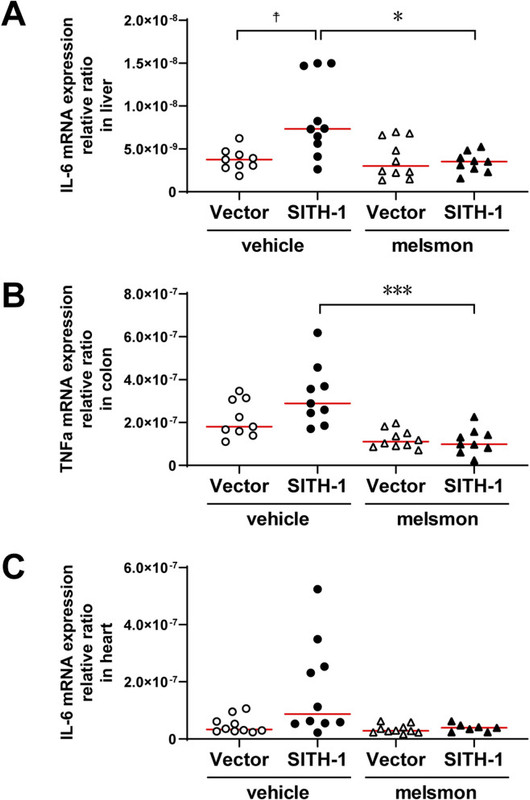
Inflammatory cytokine expression in peripheral organs of stressed mice, with and without Melsmon treatment. Oka et al., 2026.
Melsmon reduced stress-induced TNF-α expression in the brain, while also reducing inflammatory markers in the liver, colon and heart. The researchers also found reduced expression of StAR, a marker associated with activation of the hypothalamic-pituitary-adrenal, or HPA, axis.
The authors interpreted these findings as evidence that Melsmon may suppress both neuroinflammation and peripheral inflammation while influencing the body's stress-response system.
That's a broader biological effect than anything specifically related to skin.
But this was a mouse study
This is the part that shouldn't get lost.
The animals weren't people receiving Melsmon for fatigue. They weren't recovering from surgery or having laser treatments, and the researchers didn't demonstrate that Melsmon improves depression, recovery time or quality of life in humans.
They measured molecular changes in a very specific experimental model. The researchers also noted several limitations, including the absence of behavioural assessments, the lack of direct circulating corticosterone measurements and the fact that they could not identify which components of Melsmon were responsible for the observed effects.
So this isn't evidence that:
Melsmon treats stress.
It is evidence that, in this particular animal model, Melsmon altered several biological responses associated with stress and inflammation.
That is a much narrower claim.
Placenta isn't one thing
There is another branch of placental research that is easy to confuse with injectable extracts.
Researchers also use actual placental tissues and extracellular-matrix materials in wound healing. Amniotic and chorionic membranes, for example, can be processed into medical products such as wound dressings, membranes and tissue-engineering scaffolds.
These materials are not Laennec or Melsmon. They work in a different way, using physical extracellular-matrix structures and the biological components retained during processing to support tissue repair.
That distinction matters.
“Placental-derived” is a category, not a mechanism.
Read the review on placental-derived biomaterials.
Why does that matter for recovery?
Recovery is essentially a controlled biological process.
After an injury or procedure, the body has to manage inflammation, oxidative stress, cell proliferation, extracellular-matrix production and tissue remodelling. If the inflammatory response is excessive or prolonged, healing can become less efficient.
This is one reason placental-derived materials have attracted attention in wound-healing research. Reviews describe effects involving inflammation, cell migration, proliferation, angiogenesis and extracellular-matrix remodelling, and placental materials have been investigated in wound management for more than a century.
Read the review on placental-derived biomaterials and wound healing
But there is an important distinction here too.
A placental biomaterial or scaffold used directly on a wound is not the same thing as an intramuscular or subcutaneous pharmaceutical extract such as Melsmon or Laennec. They may share some biological properties, but they are different preparations used in different ways.
The oxidative-stress connection
Another recurring theme is oxidative stress.
Reactive oxygen species aren't automatically bad. They are involved in normal cell signalling and immune defence, including the early stages of wound healing. The problem is excessive or prolonged oxidative stress, which can damage proteins, lipids and DNA and contribute to persistent inflammation and cellular dysfunction.
This is why researchers have been interested in whether placental extracts can influence antioxidant pathways such as NRF2.
A laboratory study of human placental extract found increased NRF2 protein expression alongside changes in antioxidant-related genes in fibroblasts exposed to oxidative stress.
Read the study on human placental extract and skin biology
Again, though, the experiment was performed in cells. It doesn't establish that an injection produces the same effect throughout a human body.
So could it help after a procedure?
This is where the evidence becomes more useful, because there are human studies looking at placental preparations and wound healing.
One randomized study followed 79 people after orthopaedic surgery and compared topical human placental extract with povidone-iodine applied to the surgical wound. All wounds healed during the 10-day study period, and the two groups had similar levels of reported pain. The placental-extract group did, however, have significantly less wound induration on day seven.
There are also older clinical studies of topical placental extract in chronic wounds, including a randomized trial in which more patients receiving placental extract achieved substantial epithelialisation than those in the control group.
That gives us some human evidence that placental preparations can influence wound healing.
But there is a very important catch.
These studies used topical placental preparations applied directly to wounds. They don't tell us that injecting Laennec or Melsmon will make someone recover faster after microneedling, laser, surgery or another aesthetic procedure. The products, routes of administration and clinical situations are different.
The study I'd still like to see is fairly straightforward: people undergoing the same aesthetic procedure, randomised to injectable Laennec or Melsmon versus placebo, with objective measurements of erythema, swelling, pain, barrier recovery and wound healing.
That would tell us whether the biology we've been looking at actually translates into a meaningful improvement in aesthetic recovery.
For now, we have a plausible biological story and some human wound-healing evidence, but we don't have strong clinical evidence that injectable Laennec or Melsmon reliably speeds recovery after aesthetic procedures.
Recovery is not the same thing as regeneration
These words can start blending together, particularly when talking about treatments that are supposed to help tissue repair.
Recovery is the process of returning from an injured or stressed state towards normal function. Regeneration implies something more ambitious: replacing or restoring damaged tissue.
A treatment that reduces inflammation might create a better environment for recovery without actually regenerating damaged tissue. A treatment that changes fibroblast behaviour might influence extracellular-matrix production without reversing biological ageing. And a change in an inflammatory marker doesn't necessarily mean that a person will heal faster or feel better.
These distinctions can sound pedantic, but they are really the difference between a plausible biological mechanism and a demonstrated clinical outcome.
So where does that leave placenta?
Somewhere between genuinely interesting biology and evidence that is still catching up with the enthusiasm surrounding it.
We have laboratory research showing effects on inflammatory signalling and antioxidant pathways, human studies investigating placental preparations in wound healing, and a 2026 study showing that Melsmon can alter several stress-induced inflammatory responses in a mouse model.
But none of that establishes that injectable placenta makes people recover faster after an aesthetic procedure.
What it does give us is a plausible biological question.
Rather than thinking of placenta as something that simply “boosts healing”, perhaps the more useful idea is that these complex biological preparations may influence the environment in which repair takes place.
That is a much more modest claim.
And, to me, a more useful one: which components are affecting which pathways, in which tissues, and whether those changes actually translate into better recovery in humans.
C·🌷
Research notes
Melsmon and stress-induced inflammation
Oka et al., 2026
Human placental extract, melsmon, suppresses stress-induced neuroinflammation and peripheral inflammation in a mouse model of depression.
Read the full study
Human placental extracts
Biological effects of human placental extracts: variations in manufacturing methods and compositions.
Read the full review
Placental-derived biomaterials and wound healing
Placental-Derived Biomaterials and Their Application to Wound Healing: A Review.
Read the full review
Human placental extract and skin biology
Human placental extract activates a wide array of gene expressions related to skin functions.
Read the full study
Human placental extract and clinical translation
Human placental extract: the feasibility of translation from basic science into clinical practice.
Read the review