Regeneration Is Becoming a Question of Environment
Regeneration Is Becoming a Question of Environment
The more I read about regenerative medicine, the harder it becomes to think of its different technologies as completely separate fields.
Mesenchymal stromal cells, extracellular vesicles, biological scaffolds, hyperbaric oxygen therapy and senolytics initially seem to belong to very different categories. One involves cells, another tiny biological packages, another physical structure, another oxygen, and another the removal of unwanted cells.
But there is a thread connecting them.
They all change the tissue microenvironment.
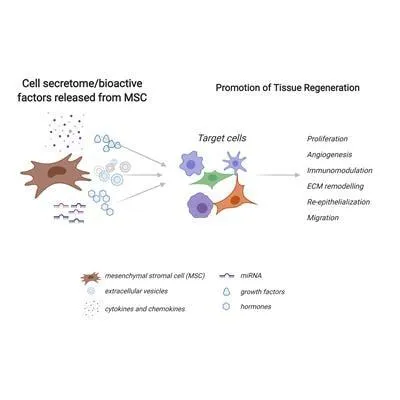
An MSC can introduce cells and trophic signals.
An extracellular vesicle can carry molecular instructions between cells.
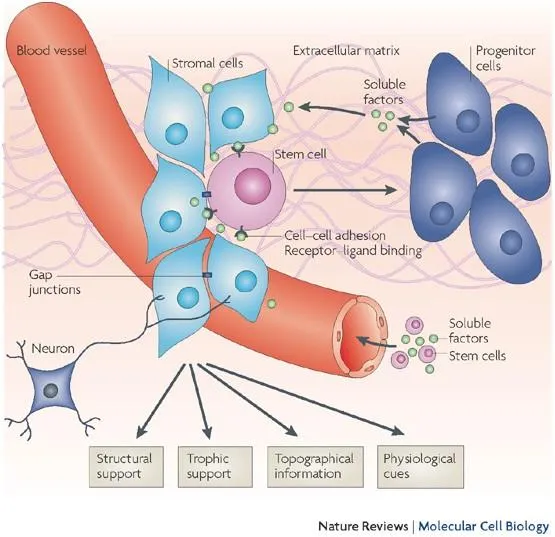
An extracellular matrix can provide both physical structure and biological cues.
HBOT can change the oxygen and redox environment.
A senolytic can remove dysfunctional cells that are altering the surrounding tissue.
Seen this way, these aren't simply different versions of a "regenerative treatment."
They are different ways of changing the conditions around the cells.
And that leads to a more interesting question.
Instead of asking:
Which regenerative product is best?
perhaps we should first ask:
What is happening in the tissue environment that is preventing repair?
The tissue is part of the treatment
A regenerative cell does not arrive in an empty space.
An MSC enters an environment containing extracellular matrix, inflammatory molecules, oxygen gradients, immune cells, damaged cells and signals from neighbouring tissue. All of these can influence what the cell actually does.
That matters because MSC behaviour is not fixed. The surrounding environment can influence their function and can even contribute to MSC senescence, potentially reducing their therapeutic activity. Emerging Landscape of Mesenchymal Stem Cell Senescence Mechanisms and Implications on Therapeutic Strategies
This makes the old mental picture of regenerative medicine feel increasingly incomplete.
We tend to imagine the therapeutic cell as the active ingredient and the damaged tissue as the passive recipient.
But biology doesn't really work that way.
The recipient tissue is part of the equation.
The same principle helps explain the growing interest in extracellular vesicles.
MSC-derived EVs contain proteins, lipids and nucleic acids that participate in communication between cells. Their therapeutic potential therefore does not necessarily depend on transplanted MSCs permanently surviving and integrating into the tissue. Increasingly, researchers are investigating whether some of the useful biological effects of MSC therapy can instead be delivered through the signals produced by the cells. Mesenchymal stromal cell-derived extracellular vesicles in regenerative medicine
This has helped drive interest in cell-free regenerative medicine.
But even an EV is still entering an environment.
And that raises another question:
What happens to the signal once it gets there?
The matrix is not just scaffolding
The extracellular matrix is easy to think about as the material that simply holds a tissue together.
It is much more interesting than that.
The matrix provides mechanical and biochemical information that can influence how cells attach, migrate, proliferate and differentiate. In other words, the structure surrounding a cell is also communicating with it.
That is one reason biological matrices and engineered biomaterials have become such an important part of regenerative medicine.
And it creates an obvious opportunity.
What if you don't simply inject a regenerative signal into damaged tissue?
What if you give that signal somewhere to stay, and an environment in which to work?
This is one of the directions emerging around MSC-derived EVs and biomaterials. Instead of delivering vesicles on their own, researchers are experimenting with hydrogels, microspheres and decellularised matrices that can protect the EVs, retain them at the target site and release them over time.
A 2026 systematic review examining bioengineered MSC-EV approaches for intervertebral disc degeneration found that biomaterial-assisted delivery systems improved EV retention, protection and sustained release in preclinical models. Bioengineered MSC-derived extracellular vesicles in intervertebral disc therapeutics
The interesting part isn't simply that the delivery system works better.
It is the underlying idea.
The delivery environment becomes part of the therapy.
And some of the newest work makes that concept even more explicit.
A 2026 study developed a microenvironment-educated MSC-EV hydrogel designed to interact with the oxidative environment of degenerating tissue and target senescent cells.
It is almost a literal implementation of the idea: don't just engineer the therapeutic signal. Engineer the environment in which the signal operates. Microenvironment-educated MSC-EVs loaded injectable smart hydrogel
Then there is oxygen
HBOT initially seems like it belongs in an entirely different category.
It isn't a cell therapy.
It isn't an EV.
It isn't a scaffold.
It changes the physical environment in which the biology is taking place.
Under hyperbaric conditions, oxygen availability changes substantially, and this can influence redox signalling, inflammation, vascular responses, cell migration and extracellular matrix remodelling. Reviews of HBOT and tissue regeneration describe effects across several of the pathways involved in tissue repair. Hyperbaric Oxygen Therapy and Tissue Regeneration: A Literature Survey
That makes HBOT interesting from the same microenvironment perspective.
It changes the oxygen and redox conditions surrounding the cells.
And oxygen is not simply fuel.
It is also a signalling variable.
That distinction matters when thinking about regenerative medicine. Rather than introducing another biological product, HBOT changes one of the environmental parameters that cells are responding to.
So the question becomes less:
"Can oxygen regenerate tissue?"
and more:
"What does changing oxygen availability do to a tissue that is trying to repair itself?"
Sometimes regeneration may require taking something away
Senolytics introduce the opposite strategy.
Instead of adding cells, signals or structural material, you remove something.
Senescent cells are not simply old cells sitting quietly in tissue. They can produce signalling molecules that alter their surroundings and influence neighbouring cells. As senescent cells accumulate, they may contribute to an environment that is less favourable to normal tissue function and repair.
That has created interest in combining senescence-targeting strategies with regenerative approaches.
A review examining the combination of cellular senescence inhibition and pro-regenerative biomaterials describes this as a potentially complementary strategy: alter the dysfunctional cellular environment while simultaneously providing conditions that support repair. Application and prospect of the therapeutic strategy of inhibiting cellular senescence combined with pro-regenerative biomaterials in regenerative medicine
It is another version of the same idea.
Sometimes regeneration may not begin by adding something.
It may begin by removing what is getting in the way.
Five ways of changing the same environment
Once you look at regenerative medicine through this lens, the categories begin to overlap.
MSC therapy changes the cellular environment by introducing cells capable of producing trophic and immunomodulatory signals.
Extracellular vesicles deliver biological instructions that can influence neighbouring cells.
ECM and biological scaffolds change the physical and biochemical environment in which cells attach, migrate and behave.
HBOT changes oxygen availability and redox signalling.
Senolytics alter the cellular composition of the environment by removing or suppressing dysfunctional senescent populations.
These are obviously not interchangeable. Their mechanisms, risks, evidence and clinical maturity are very different.
But they share a conceptual target.
The environment in which regeneration has to happen.
The convergence is the interesting part
This is where I think regenerative medicine starts to become particularly fascinating. The field may be moving away from the idea that regeneration comes from finding one extraordinary product and simply putting it into damaged tissue. Instead, researchers are increasingly asking whether the regenerative environment itself can be understood, manipulated and, eventually, designed.
That means looking at the tissue as a system rather than focusing on a single intervention. What signals are present? What kind of matrix surrounds the cells, and how does it influence their behaviour? How long does a therapeutic signal remain in the tissue? What is happening with oxygen and redox signalling? Which inflammatory pathways are active? And are senescent or otherwise dysfunctional cells interfering with the repair process?
Perhaps the most important question is the simplest one: is the tissue actually in a state where regeneration can succeed?
A 2026 review of MSC-derived extracellular vesicles highlights several of the directions now shaping the field, including bioengineering, delivery systems, standardisation and indication-specific design. Mesenchymal stromal cell-derived extracellular vesicles in regenerative medicine: Standardisation, bioengineering and clinical translation
That is a very different vision of regenerative medicine from simply injecting cells and hoping they produce the desired effect. It starts to look more like tissue engineering at the level of the microenvironment, where the aim is not only to introduce a therapeutic component, but to create conditions in which that component can actually function.
You could imagine a future regenerative therapy being designed around several questions at once. Are the necessary cellular capabilities present? If not, could MSCs or another cell population provide them? What biological signals are missing, and could EVs or other signalling molecules supply them? Does the extracellular matrix provide the right structural and mechanical cues? Is the oxygen environment supportive of repair? And is there a population of dysfunctional or senescent cells actively working against the process?
That doesn't mean the answer will simply be to combine everything.
Biology is considerably less cooperative than a diagram makes it look. Adding more regenerative technologies does not automatically produce more regeneration. Timing matters, dose matters, tissue type matters and delivery matters. Two interventions that look complementary on paper may interact in ways that are neutral, unpredictable or even counterproductive. Much of the most interesting work is also still preclinical, so there is a considerable distance between an elegant laboratory system and something that is safe and effective in people.
But the conceptual shift is fascinating.
Perhaps the next generation of regenerative medicine will not be defined by finding a single "regenerative product." Perhaps it will increasingly be about engineering the conditions under which the tissue can repair itself.
That brings the different pieces back together: cells, signals, matrix, oxygen and cellular state. They are different biological levers, but they all influence the same underlying question: what kind of environment are we creating for repair?
And that changes the question I keep coming back to.
Not simply:
What can we add to the tissue?
But:
What does this tissue need in order to repair itself?
C·🌷
Further reading
- Bioengineered MSC-derived extracellular vesicles in intervertebral disc therapeutics: A systematic review (2026)
- Microenvironment-educated MSC-EVs loaded injectable smart hydrogel (2026)
- Mesenchymal stromal cell-derived extracellular vesicles in regenerative medicine: Standardisation, bioengineering and clinical translation (2025)
- Mesenchymal Stem Cells and Extracellular Vesicles: Bridging the Translational Gap in Regenerative Medicine (2026)
- Application and prospect of inhibiting cellular senescence combined with pro-regenerative biomaterials (2023)
- Hyperbaric Oxygen Therapy and Tissue Regeneration: A Literature Survey (2022)
- Survey of Molecular Mechanisms of Hyperbaric Oxygen in Tissue Repair (2021)