So What Is Actually Inside Placenta Extract?
The chemistry behind Laennec, Melsmon and the idea of a “regenerative” injection
There is something slightly strange about the phrase “placenta injection”.
It makes it sound as though someone has taken a placenta, put it in a bottle and decided that this is probably good for you. Obviously, that isn't what is happening.
Laennec and Melsmon are pharmaceutical preparations made from human placental tissue. The placenta is processed, hydrolysed and purified, leaving behind a mixture of smaller biological components. Once you start looking at the finished product rather than the word “placenta”, the story becomes considerably more complicated.
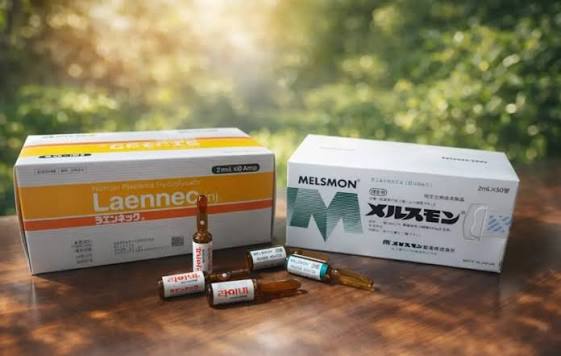
A placenta is not one ingredient
The placenta is an extraordinarily complicated piece of biology. During pregnancy it acts as an interface between mother and fetus, but it is also an endocrine and metabolically active organ that produces hormones, growth-related signals and many other biological molecules.
A placental extract isn't simply a concentrated version of everything that was present in the original tissue.
The manufacturing process changes the material. The tissue is processed, hydrolysed and purified, and many of the original larger molecules are broken down into smaller components.
A 2025 review comparing human placental extracts found substantial differences between products depending on the source tissue, the part of the placenta used and the manufacturing method.
So the useful question isn't simply what is in placenta?
It is what is left in this particular placenta extract?
Melsmon is mostly a low-molecular-weight mixture
Melsmon is made using hydrochloric-acid hydrolysis. The manufacturing process begins with screened human term placenta, with the umbilical cord removed and the placental villous tissue processed to remove blood before extraction and purification.
The pH is then adjusted and benzyl alcohol is added before the final preparation is sterilised.
The resulting preparation contains a mixture of amino acids and other low-molecular-weight substances. One analysis reported 16 amino acids in Melsmon, including glutamic acid, aspartic acid, leucine, glycine, arginine, alanine and lysine, along with reported carbohydrate-related components and fatty acids.
That is rather less glamorous than simply saying “placenta”, but it is probably a more accurate description of what is actually sitting in the ampoule.
The injection isn't relying on some mysterious intact placenta molecule. It is a processed mixture of biological building blocks and other compounds produced by the manufacturing process.
Laennec is made differently
Laennec also undergoes hydrolysis, but the manufacturing process is different.
The placenta is refrigerated, washed and dissected before being homogenised, defatted and dried. The material is then treated with hydrochloric acid and digested with pepsin before further hydrolysis and purification.
That difference matters because the way a biological material is broken down influences the molecules that remain in the finished preparation.
The 2025 review notes that hydrochloric-acid hydrolysis tends to produce more low-molecular-weight components, while protease-based processing can leave relatively higher-molecular-weight peptides.
So even though Laennec and Melsmon start with the same broad biological source, the chemistry isn't identical.
How you make the extract changes what you end up injecting.
What has actually been identified in Laennec?
Laennec has been analysed for decades, with older studies identifying a range of amino acids including glutamic acid, aspartic acid, glycine, alanine, leucine, serine and threonine.
More recently, researchers have been able to look at the preparation in much greater molecular detail.
A 2023 proteomic study used mass spectrometry to identify 41 peptides in Laennec, each consisting of four to eight amino-acid residues. The researchers then used bioinformatic analysis to investigate possible biological targets associated with those peptides.
Among the pathways identified were proteins involved in apoptosis, MAP kinase signalling and the AKT/GSK3B/MTOR pathway.
Those findings tell us something about the molecular complexity of the preparation, but they don't tell us exactly what those peptides do after an injection in a human.
Identifying a peptide and finding a possible biological target is a very different thing from demonstrating a clinical effect.
That distinction becomes particularly important with placental extracts because the final composition depends on the manufacturing process.
Where does the “regeneration” language come from?
Placental extracts have been investigated for a wide range of biological effects in laboratory and animal research. The 2025 review describes reported antioxidant, anti-inflammatory and immunomodulatory effects, alongside research involving cell proliferation, tissue repair and wound healing.
There are also studies looking specifically at skin biology.
A 2022 Scientific Reports study exposed cultured human dermal fibroblasts to human placental extract and found increased expression of genes including COL1A1, ELN and HAS2. The researchers also reported increases in type I collagen, elastin, versican and hyaluronan in the experimental system.
That gives us a possible biological explanation for why placental extracts keep appearing in conversations about collagen and skin quality.
But the experiment happened in cultured cells.
It doesn't tell us that injecting Laennec or Melsmon into human facial skin will produce the same response.
The distinction is important because laboratory biology can show us what a material can do under controlled conditions, while a clinical study asks what actually happens to people.
What about growth factors?
This is another place where the word “placenta” can create assumptions.
The placenta naturally produces many growth factors, hormones and signalling molecules, so it is tempting to assume that a placental extract simply contains large amounts of all of them.
The manufacturing process makes that much less straightforward.
Hydrolysis can break down proteins and alter the final composition. Some larger molecules may be degraded, while smaller peptides, amino acids and other compounds remain.
So when someone says:
“Placenta contains growth factors.”
the next question is more useful:
Which growth factors are actually present in the finished product, at what concentration, and are they still biologically active after processing?
Those are much harder questions to answer.
There aren't stem cells floating around in the ampoule
This distinction matters even more now that placental products are sometimes discussed alongside stem-cell therapies.
Human placental extracts are not the same thing as a cellular therapy. The extraction and sterilisation processes remove viable cells, leaving an extract containing molecules and molecular fragments derived from the original tissue.
A review examining the translation of human placental extracts into clinical practice describes this distinction directly. Cellular hydrolysis eliminates viable placental cells while leaving behind extracellular-matrix components and smaller biological molecules.
So Laennec isn't injecting living placental stem cells into your skin.
That puts it in a very different category from an actual placental or umbilical-derived cell therapy, where the therapeutic material is intended to contain viable cells.
The two ideas are often placed next to each other because they share a biological source, but they are not the same treatment.
Then what is the body actually receiving?
The simplest way I can describe it is that the body isn't receiving a little piece of placenta.
It is receiving the processed chemical aftermath of placenta: a complex mixture of amino acids, peptides and other low-molecular-weight substances, with the exact composition depending on the product and how it was manufactured.
Some of these molecules may act as substrates. Others may interact with receptors or signalling pathways. Some have been investigated in relation to inflammation and oxidative stress, while others may have biological effects that we still don't fully understand.
And some will simply be broken down and cleared by the body.
Not every molecule in a biological extract needs to have a dramatic biological effect.
That is part of what makes these products difficult to study. They aren't one molecule with one receptor and one clean mechanism.
They are mixtures.
Laennec and Melsmon aren't interchangeable
At first glance, both can be described simply as “human placenta injections”.
Look underneath the label, however, and the differences start to accumulate.
They have different manufacturing processes, different hydrolysis methods, different concentrations, different chemical profiles, different approved indications and different research histories.
The 2025 review makes the broader point that even extracts made from the same biological source can have different compositions and potentially different biological effects depending on how they are manufactured.
That makes “which one is stronger?” a surprisingly unhelpful question.
A better question is what is actually in the preparation, how it got there, and what evidence exists for what it does.
And then there is the problem of the word “active”
With a conventional drug, we often have a satisfying story.
One molecule. One target. One receptor. One pathway.
Placental extracts don't necessarily behave like that.
They are mixtures, and those mixtures can contain multiple components acting through different biological pathways at the same time. That makes them harder to study, but it also makes them harder to describe accurately.
Saying “this is a complex mixture of peptides and low-molecular-weight compounds whose biological activity is still being characterised” doesn't fit very neatly on an Instagram post.
“Regenerative placenta injection” does.
The shorter description is easier to sell, but it leaves out most of the chemistry.
So what might actually be doing the work?
The honest answer is that we don't know yet.
Researchers have identified amino acids and peptides, observed changes in gene expression, and investigated effects involving fibroblasts, inflammatory signalling and oxidative stress.
What remains much less certain is the complete relationship between composition, mechanism and clinical outcome.
The 2025 review concludes that the chemical composition of human placental extracts remains incompletely characterised and that many potentially active components and mechanisms have yet to be identified.
There is also newer research moving beyond skin. A 2026 study investigated Melsmon in a stress-sensitive mouse model and found reductions in stress-induced neuroinflammation and peripheral inflammation, along with effects on pathways involved in the body's stress response.
The researchers could not identify which specific components of Melsmon were responsible for those effects, and the work remains animal research.
So we have pieces of the biological story, but not a complete map from molecule → mechanism → injection → human outcome.
A biological mixture is a different kind of medicine
Perhaps that is the part I keep coming back to.
Placental extracts don't fit neatly into the usual way we like to talk about drugs. They aren't a single fashionable molecule with a single target, and they aren't a cellular therapy containing living stem cells.
They sit somewhere in between those familiar categories: a processed biological material containing a complicated mixture of smaller molecules whose composition is shaped by the tissue source and the manufacturing process.
That makes them difficult to study.
It also means that two products can come from the same biological source and still be quite different once they reach the final ampoule.
For me, that changes the way I think about the whole category.
Instead of asking whether “placenta” works, I want to know which preparation, which components, which biological effects, and which outcomes have actually been studied.
That is a much more useful question than treating placenta as though it were one ingredient.
And now I look at my little collection differently
When I first started looking into Laennec and Melsmon, the easiest way to describe them was simply as placenta injections.
And now I look at my little collection differently.
They aren't stem cells. They aren't intact placenta, and they aren't one mysterious regenerative molecule. They are processed biological mixtures, shaped by the tissue they came from and by the way they were manufactured.
We know some of the components. We know some of the pathways they can influence in laboratory models. We have clinical histories for some of these preparations, although the evidence is uneven and the gap between laboratory biology and human outcomes remains substantial.
There is still a lot we don't know.
For something that arrives in such a small amber ampoule, there is an enormous amount of biology hiding inside it.
C·🌷
Research notes
Human placental extracts Biological effects of human placental extracts: variations in manufacturing methods and compositions. Read the full review
Laennec peptide composition The molecular mechanisms of the effect of standardized placental hydrolysate peptides on mitochondria functioning. Read the study
Human placental extract and skin biology Chang et al., 2022 Human placental extract activates a wide array of gene expressions related to skin functions. Read the study
Human placental extract and clinical translation Human placental extract: the feasibility of translation from basic science into clinical practice. Read the review
Melsmon and stress-induced inflammation 2026 Effects of Melsmon on stress-induced neuroinflammation and peripheral inflammation. Read the study
Laennec Japan Bio Products Official product information and composition. Read the manufacturer information
Melsmon Melsmon Pharmaceutical Co., Ltd. Official medical information and composition. Read the manufacturer information