The Next Big Thing in Regenerative Medicine Isn’t a Product
The more I read about regenerative medicine, the more interesting the convergence becomes.
MSC therapies, extracellular vesicles, biological scaffolds, HBOT and senolytics can look like completely separate technologies. But they are all, in different ways, modifying the tissue microenvironment.
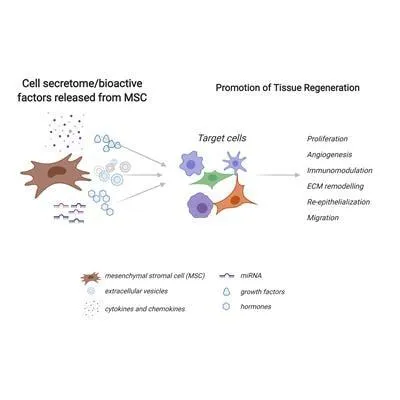
MSC: cells and trophic signalling EVs: cell-to-cell communication ECM/HADM: structural and biological cues HBOT: oxygen and redox environment Senolytics: removal of dysfunctional cellular populations
That changes the question.
Instead of asking which "regenerative" product is best, we can ask:
What is happening in the tissue environment that is preventing repair?
The environment matters
An MSC does not operate in isolation.
Its behaviour is influenced by the surrounding matrix, inflammatory signals, oxygen availability and the other cells around it. The microenvironment can even influence whether MSCs themselves become senescent, which has obvious implications for their therapeutic potential. Emerging Landscape of Mesenchymal Stem Cell Senescence Mechanisms and Implications on Therapeutic Strategies
EVs add another layer. MSC-derived extracellular vesicles carry proteins, lipids and nucleic acids involved in cell-to-cell communication and tissue repair. This is one reason the field has increasingly moved toward cell-free regenerative medicine, rather than assuming the therapeutic effect of MSCs necessarily requires the cells themselves to engraft. Mesenchymal stromal cell-derived extracellular vesicles in regenerative medicine
And then there is the matrix.
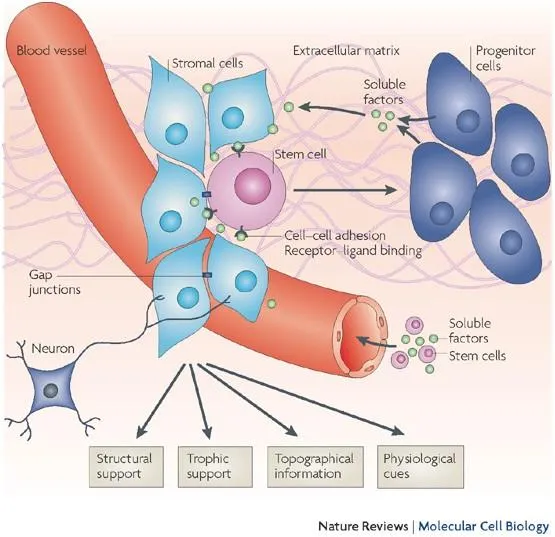
ECM is more than scaffolding
The extracellular matrix is not simply structural material holding tissue together.
It provides biochemical and mechanical cues that influence cell adhesion, migration, proliferation and differentiation. This is part of why biological matrices and engineered biomaterials are becoming such an important part of regenerative medicine.
One particularly interesting direction is combining MSC-derived EVs with biomaterials so that the vesicles are protected, retained and released within the target tissue rather than simply injected and left to disperse.
A 2026 systematic review of MSC-EVs for intervertebral disc degeneration found that biomaterial-assisted systems including hydrogels, microspheres and decellularised matrix scaffolds improved EV retention, protection and sustained release in preclinical models. Bioengineered MSC-derived extracellular vesicles in intervertebral disc therapeutics
Even more interestingly, a 2026 study developed a microenvironment-educated MSC-EV hydrogel designed to target senescent cells and respond to the oxidative environment of degenerating tissue. It is a very literal example of the idea: engineer the therapy and engineer the environment in which the therapy operates. Microenvironment-educated MSC-EVs loaded injectable smart hydrogel
Oxygen changes the environment too
HBOT initially looks like a completely different category.
It is not a cell therapy, an EV therapy or a scaffold.
It changes the physical environment.
Oxygen availability influences redox signalling, inflammation, vascular responses and cellular behaviour. Reviews of HBOT and tissue repair describe effects across pathways involved in oxidative stress, angiogenesis, inflammation, cell migration, extracellular matrix remodelling and tissue regeneration. Hyperbaric Oxygen Therapy and Tissue Regeneration: A Literature Survey
So in this framework:
HBOT = changing the oxygen/redox environment
And that is conceptually very different from simply adding another biological product.
Sometimes regeneration may require subtraction
Senolytics introduce another interesting possibility.
Instead of adding something to damaged tissue, you remove something.
Senescent cells can accumulate with age and after injury, creating a signalling environment that can interfere with tissue repair. Researchers are increasingly interested in combining strategies that target cellular senescence with regenerative biomaterials designed to support repair. Application and prospect of the therapeutic strategy of inhibiting cellular senescence combined with pro-regenerative biomaterials in regenerative medicine
So the model becomes:
MSC → add cells and trophic signals
EV → add biological instructions
ECM → provide structure and cues
HBOT → alter oxygen and redox signalling
Senolytics → remove dysfunctional cellular populations
None of these is necessarily "the regenerative treatment."
They are different ways of changing the conditions in which regeneration happens.
The convergence
This is the part I find most interesting.
Regenerative medicine may be moving away from the idea of a single product that somehow "regenerates" tissue.
Instead, we may increasingly be looking at the microenvironment itself as a therapeutic target.
A 2026 review of MSC-EVs describes the field moving toward bioengineering, delivery platforms, standardised dosing and indication-specific design. Mesenchymal stromal cell-derived extracellular vesicles in regenerative medicine
And the newer work is beginning to look remarkably combinatorial: engineered EVs, smart hydrogels, ECM scaffolds, senescence-targeting strategies and environmental cues being designed to work together.
That does not mean combining every regenerative technology will automatically produce better regeneration. Biology is considerably less cooperative than a diagram makes it look, and timing, dose, tissue type and safety still matter.
But the conceptual shift is fascinating.
Maybe the next generation of regenerative medicine won't be about finding the magic regenerative product.
Maybe it will be about engineering the conditions under which tissue can repair itself.
Cells + signals + matrix + oxygen + cellular state.
The interesting question may no longer be:
What can we add to the tissue?
It may be:
What does the tissue need in order to repair itself?
Further reading
- Bioengineered MSC-derived extracellular vesicles in intervertebral disc therapeutics: A systematic review (2026)
- Microenvironment-educated MSC-EVs loaded injectable smart hydrogel (2026)
- Mesenchymal stromal cell-derived extracellular vesicles in regenerative medicine: Standardisation, bioengineering and clinical translation (2025)
- Mesenchymal Stem Cells and Extracellular Vesicles: Bridging the Translational Gap in Regenerative Medicine (2026)
- Application and prospect of inhibiting cellular senescence combined with pro-regenerative biomaterials (2023)
- Hyperbaric Oxygen Therapy and Tissue Regeneration: A Literature Survey (2022)
- Survey of Molecular Mechanisms of Hyperbaric Oxygen in Tissue Repair (2021)