The Skin Printer
Picking up the thread
The last question was whether we can measure the biology of ageing skin.
This time, I'm following that question somewhere stranger: what happens when researchers try to recreate ageing skin itself?
The trail so far
The Skin Age Question Measuring skin ageing.
The Skin Printer Modelling ageing skin.
What happens when we stop measuring ageing skin and start trying to build it?
There is something slightly misleading about the phrase "3D-printed skin". It sounds as though human skin has somehow been loaded into a printer and reproduced layer by layer.
That isn't quite what is happening.
The printing is often used to create something much more fundamental: the physical architecture in which skin cells can grow, organise themselves and interact with their surroundings.
Printing the architecture
Human skin is not simply a collection of cells. Those cells exist within an intricate physical environment called the extracellular matrix, or ECM. It provides structural support, influences how cells behave and contributes to the mechanical properties of the tissue.
So if you want to build a useful model of skin, putting the right cells together is only part of the problem. You also need to recreate something resembling the environment in which those cells normally exist.
This is where Melt Electrowriting, or MEW, comes in.
MEW is a high-resolution form of 3D printing that can produce extremely fine polymer fibres. An electric field draws molten polymer from a nozzle into microscopic threads, which can then be arranged into a precisely controlled three-dimensional scaffold.
It is less like printing a piece of skin and more like constructing a microscopic framework for cells to grow through.
In research involving L'Oréal Advanced Research and the University of Oregon, MEW was used to create scaffolds designed to reproduce aspects of the extracellular matrix of human skin.

Microscopic architecture of a melt-electrowritten skin scaffold. Image: L'Oréal Research & Innovation.
The full study, published in Advanced Functional Materials, describes how these engineered scaffolds were combined with other materials to create a more realistic bilayer skin model.
Then the cells do the rest
The scaffold itself isn't the skin. Cultured cells are introduced into the structure and allowed to grow within it.
In the 2024 study, researchers combined a melt-electrowritten dermal scaffold with an electrospun membrane to create a bilayer model containing fibroblasts and keratinocytes, the major cell populations responsible for forming the dermis and epidermis.
After 18 days, the model had developed a differentiated epidermis and a dermis containing newly synthesised extracellular matrix, including collagen and elastin.
The architecture of the scaffold also influenced how collagen was organised within the developing tissue.
That distinction matters. The goal isn't simply to create something that resembles skin when viewed from the outside. It is to create an environment in which cells behave, communicate and organise themselves in ways that more closely resemble actual tissue.
Why does the structure matter?
Because ageing doesn't happen to isolated cells.
The environment around those cells changes too. The extracellular matrix becomes less organised, collagen and elastin change, mechanical properties shift, and cells receive different physical and biochemical signals from the tissue surrounding them.
A model containing the right cells but none of that physical context can therefore miss part of the biology.
Recreating some of the tissue architecture gives researchers another variable to work with. Instead of asking only what individual cells are doing, they can begin examining how the cells and their surrounding matrix influence one another.
That makes the model closer to a piece of tissue rather than simply a collection of cultured cells.
What happens when the skin itself is aged?
The 2024 work was primarily about building a more sophisticated model of human skin.
L'Oréal's newer work takes the idea a step further: can we build models that reproduce characteristics of ageing skin?
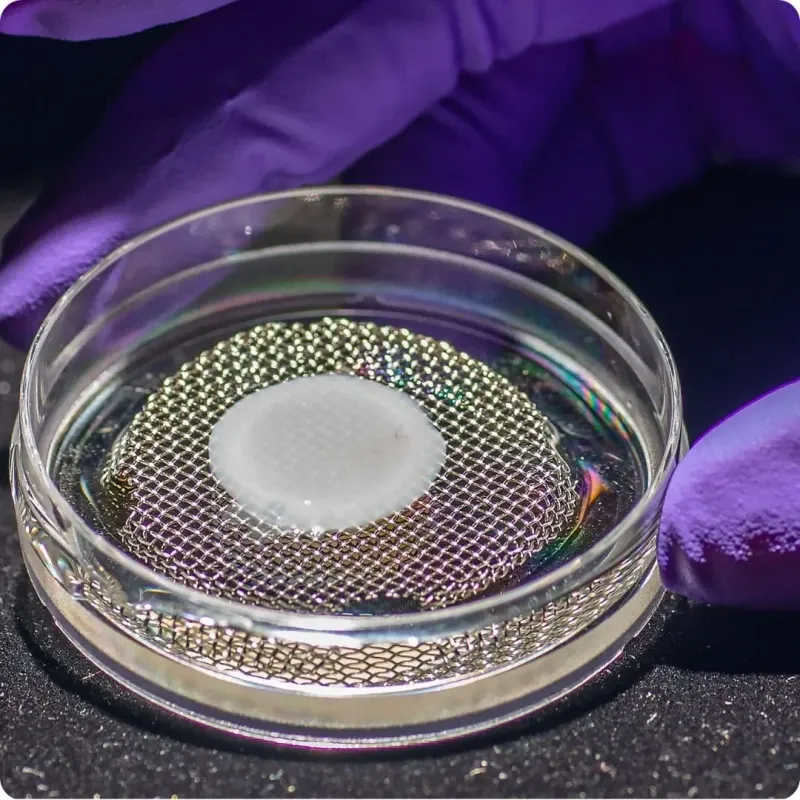
Engineered skin structure created using Melt Electrowriting. Image: University of Oregon / L'Oréal.
In its 2026 Human Skin Bio-Engineering programme, developed with the University of Oregon, L'Oréal describes using Melt Electrowriting to create ultra-fine fibres that reproduce aspects of the skin's extracellular matrix.
These structures can then be used as environments in which cells with different characteristics can be studied, including models designed to reproduce aspects of biological ageing and fibrosis.
The objective isn't simply to make tissue look older.
It is to reproduce some of the biological and mechanical characteristics associated with ageing tissue, creating a controlled environment in which researchers can investigate what happens when particular molecules or formulations are introduced.
L'Oréal's Human Skin Bio-Engineering programme describes the broader approach, which combines tissue engineering with biological and mechanical measurements to study skin at different ages and levels of organisation.
Why build ageing skin?
Because testing an anti-ageing treatment on young, healthy reconstructed skin only tells you so much.
Ageing changes the tissue itself.
If researchers can create a model that captures some of those changes, they gain a controlled system in which much more specific questions can be asked.
What happens to aged tissue when a particular molecule is introduced?
Can its mechanical properties change?
Does the extracellular matrix become more organised?
Can characteristics associated with structural ageing be altered?
And perhaps most importantly, can researchers investigate those questions before moving to testing in people?
That is one of the main reasons these models matter. They allow individual variables to be manipulated under controlled conditions, something that is much harder to do in a living human being.
From testing products to testing biology
Reconstructed skin has been used for decades to study ingredients, formulations, irritation and aspects of skin biology.
The newer approach is more ambitious.
Instead of treating skin simply as a surface on which a product produces a visible effect, researchers can study it as a biological system with measurable structure, mechanics, extracellular matrix organisation and cellular behaviour.
That creates a different way of thinking about cosmetic research.
Rather than asking only whether a formulation makes skin appear smoother, researchers can potentially investigate what happens to the tissue itself, how its structure changes and which biological pathways are affected.
L'Oréal describes this newer work as bringing together biology, mechanics and electronics to investigate skin at different ages and levels of organisation.
The model doesn't need to reproduce every aspect of human skin to be useful. It needs to reproduce the particular features that researchers are trying to understand.
But there is an important catch
A model is still a model.
Even a sophisticated reconstructed skin model is not a complete human face. Real skin exists within a much larger biological system, with blood vessels, nerves, immune cells, hormones, microbiota and continuous interaction with the rest of the body.
Ageing doesn't happen in exactly the same way in every person either.
So the value of these models isn't that they perfectly recreate a human being. Their value is that they provide a controlled experimental system in which specific variables can be changed and measured.
That can tell researchers something a photograph never could.
A photograph can tell you what ageing looks like.
A molecular assay can tell you something about the biology associated with it.
A reconstructed tissue model gives you the opportunity to manipulate some of that biology and observe what happens.
The strange part
We started this little trail by asking how old skin actually is.
Then came ways of measuring it, from visual assessments to DNA methylation and protein biomarkers.
Now we're asking whether some of those characteristics can be recreated in a laboratory model of ageing skin.
The technology is still developing, and claims about what these models can predict will need to be tested independently. A reconstructed tissue model is not a substitute for a human clinical study, and reproducing one aspect of ageing does not mean reproducing ageing itself.
But the direction of travel is becoming clearer.
We're moving from asking what ageing skin looks like, to asking what is happening inside it, and then towards building experimental systems that allow researchers to manipulate some of those changes.
If we can build ageing tissue, perhaps the next question is whether we can build a better way of testing how to make it age differently.
The trail so far
The Skin Age Question Measuring the biology of ageing skin.
The Skin Printer Trying to recreate aspects of ageing skin in the laboratory.
C·🌷
Research notes
Bilayer skin tissue engineering Girard et al., 2024 First Advanced Bilayer Scaffolds for Tailored Skin Tissue Engineering Produced via Electrospinning and Melt Electrowriting. Full study
Human Skin Bio-Engineering L'Oréal Research & Innovation, 2026 Human Skin Bio-Engineering. Research overview
3D bioprinted skin models L'Oréal Research & Innovation × University of Oregon L'Oréal's Collaborative Breakthrough in 3D Bioprinted Skin Models with University of Oregon. Research overview
University of Oregon More realistic artificial skin may lead to medical advances. Research story