When the Machine Judges Your Skin
According to what?
If someone tells you your skin age is 37, what exactly produced that number? A photograph, a wrinkle score, a dermatologist, a machine-learning model, or something measuring the biology underneath the surface?
We've already looked at some of the ways researchers are trying to measure ageing skin. Now the question gets a little more interesting:
What happens when the thing judging your skin is a machine?
From looking at skin to measuring it
For a long time, assessing skin ageing meant looking carefully. Wrinkles could be scored, pigmentation graded, and changes in pores, redness, texture and sagging compared against photographic scales. Useful, certainly, but still dependent on human observation.
So researchers started asking whether some of this could be automated. Instead of asking a person how pronounced a wrinkle looks, perhaps an algorithm could learn the visual patterns associated with different grades and apply them consistently across thousands of images.
A 2023 study involving researchers from L'Oréal Research & Innovation and collaborators analysed selfie photographs from 1,041 women in the United States, aged 18 to 80 and representing different ancestries and Fitzpatrick skin phototypes. An AI system assessed seven visible facial signs, including forehead and eye-area wrinkles, nasolabial folds, pigmentary spots, lower-face sagging, diffuse redness and cheek pores, and compared the results with assessments from 50 dermatologists.
For five of the seven features, the automated assessments showed strong correlations with the dermatologists' scores. Pores showed a moderate correlation, while pigmentation was more difficult, particularly in the darkest phototypes.
That distinction matters because the system wasn't simply being asked, “How old does this face look?” It was being asked to identify specific visible characteristics of ageing.
That is a much more useful question.
But what exactly is the machine seeing?
A photograph contains a surprising amount of information. Wrinkles, pigmentation, texture, pores, facial geometry, sagging and redness are visible to some degree, but so are lighting, expression, makeup, camera quality and the angle of the photograph.
An algorithm can become very good at recognising patterns associated with chronological age without actually measuring biological age. Someone might have relatively few visible wrinkles while experiencing substantial changes beneath the surface, while someone else might have considerable photoageing without the same changes occurring elsewhere in their biology.
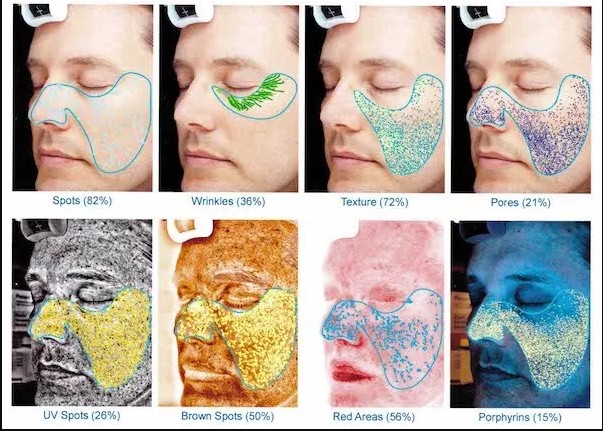
A VISIA complexion-analysis system separates a facial image into different measurable features, including spots, wrinkles, texture, pores, UV spots, brown spots, red areas and porphyrins. The image illustrates how “skin analysis” can involve several distinct measurements rather than one overall skin-age score.
That doesn't necessarily mean it has measured biological age.
So how accurate can a machine be?
A 2025 systematic review looked at machine-learning approaches to determining skin age. The researchers screened 1,467 non-duplicate articles, but only 27 studies met their inclusion criteria. Reported mean absolute errors ranged from 2.30 to 8.16 years.
That is quite a range.
The models weren't all doing the same thing either. Most relied on facial images, while some incorporated less visible biological information such as methylome and proteome data. The review also identified limitations including small sample sizes, risk of bias and insufficient diversity in some datasets.
So “AI can measure your skin age” is actually a rather broad statement. It might mean an algorithm estimating age from a photograph, or it might involve much more specialised imaging or biological information.
Those are very different measurements.
Read the 2025 systematic review
Machines have biases too
We sometimes talk about AI as though it removes human subjectivity. It can reduce some forms of it, but it can also reproduce patterns and biases contained in its training data.
A 2022 Scientific Reports study comparing human age perception with several AI facial-age estimation systems found that the AI systems showed many of the same biases as humans, with some becoming even more pronounced. Facial expression affected age estimates, and performance varied across age and sex.
The machine wasn't looking at a face from some perfectly neutral perspective. It had learned from other faces, and those faces came from particular datasets and populations.
Read the Scientific Reports study
And then there is skin tone
This is particularly important for skin analysis.
The 2023 L'Oréal study deliberately included different ancestries and Fitzpatrick skin phototypes, yet pigmentation was still the most difficult of the seven facial features for the system to assess, particularly in the darkest phototypes.
A separate 2022 study of dermatology AI found that several models performed substantially worse on a more diverse dataset, particularly for darker skin tones and uncommon diseases. Adding more diverse training images could reduce some of that performance gap.
So diversity isn't simply an ethical consideration.
It is part of the technical problem.
If a dataset doesn't adequately represent the people a model is supposed to work on, the model has less opportunity to learn how those people actually look.
Read the Diverse Dermatology Images study
A machine can measure more than a photograph
This is where skin analysis gets considerably more interesting.
Researchers can use controlled lighting, multispectral imaging, three-dimensional surface measurements and other techniques to capture information that isn't obvious from an ordinary photograph. Different wavelengths can reveal different features, while 3D imaging can provide information about surface structure.
The machine isn't necessarily becoming better at seeing.
It's being given more information to work with.
Even then, it is measuring something specific: a wrinkle, a pigmentary change, a colour signal, a surface contour or an image-derived biomarker. Those measurements can be useful without representing everything happening inside the skin.
Ageing is not one process. Collagen and the extracellular matrix change, cellular behaviour changes, barrier function shifts, inflammatory signalling changes and pigment production changes. Some of these changes are visible from the surface; others require molecular or epigenetic measurements.
Perhaps the future is a profile
Instead of reducing everything to a single skin-age number, future systems may give us a much more detailed picture: visible ageing, pigmentation, texture, photoageing and, eventually, information from imaging or biological markers.
That would also make it possible to track change over time. If someone undergoes a treatment, we could look at what actually changed in the skin, rather than simply asking whether they look younger.
This brings together the different ways researchers are beginning to study ageing skin. Photographs tell us about appearance. Imaging can give us more information about structure. Molecular and epigenetic measurements can tell us about processes that aren't visible from the surface.
None of these tells the whole story on its own.
And perhaps that is why I'm slightly suspicious of the neat little number that appears on a screen:
Skin age: 37.
It sounds wonderfully precise.
But before accepting it, I'd still like to know:
According to what?
C·🌷
Research notes
Machine learning and skin age
McMullen et al., 2025
Machine learning methods for determining skin age: A systematic review.
Read the original study
AI analysis of facial signs
Flament et al., 2023
Accuracy and clinical relevance of an automated, algorithm-based analysis of facial signs from selfie images of women in the United States of various ages, ancestries and phototypes.
Read the original study
Bias in facial age estimation
Ganel et al., 2022
Biases in human perception of facial age are present and more exaggerated in current AI technology.
Read the original study
Diversity in dermatology AI
Daneshjou et al., 2022
Disparities in dermatology AI performance on a diverse, curated clinical image set.
Read the original study