Laennec or Melsmon? They're Not Quite the Same Thing.
Same placenta, very different stories
Same source, different preparation, different history
There is a point in every placenta journey where you stop saying “placenta injections” and start having opinions about brands.
Laennec people. Melsmon people. People who swear one is better for skin while the other is better for women's health. And then there is me, quietly maintaining an emotional support supply of both, with a third Korean placenta product called Melamin now sitting in the cupboard as well.
The more I looked into them, the less useful the word “placenta” seemed. Laennec, Melsmon and Melamin all come from human placental tissue, but they have different manufacturers, different formulations, different medical histories and different evidence behind them.
So I wanted to put them next to each other and work out what actually separates them.
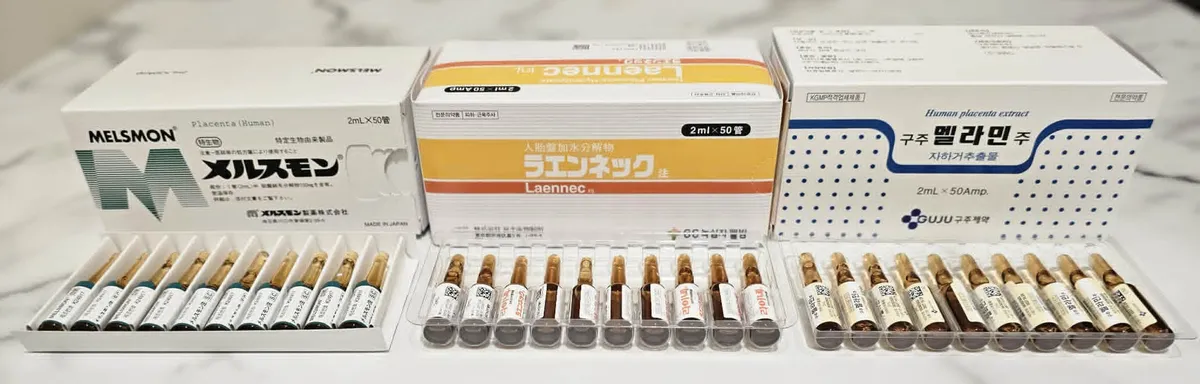
Three products, one rather broad category
At a glance, Laennec, Melsmon and Melamin can look like variations on the same idea. They are all pharmaceutical human-placental preparations, but the similarities only tell part of the story.
| Laennec | Melsmon | Guju Melamin | |
|---|---|---|---|
| Country | Japan | Japan | South Korea |
| Manufacturer | Japan Bio Products | Melsmon Pharmaceutical | GuJu Pharma |
| Source | Human placenta | Human placenta | Human placenta |
| Main approved indication | Improvement of hepatic function in chronic liver disease | Menopausal disorders / insufficient lactation | Improvement of menopausal-disorder symptoms |
| Preparation | Placental hydrolysate | Placental hydrolysate | Human placenta extract |
| Typical format | 2 mL ampoule | 2 mL ampoule | 2 mL ampoule |
| Pharmaceutical product | Yes | Yes | Yes |
| Same formulation? | No | No | No |
| Product-specific published evidence | More substantial | More substantial | Limited / not readily located |
Laennec contains 112 mg of water-soluble human placental hydrolysate in each 2 mL ampoule. Melsmon contains 100 mg of water-soluble human placental villous-tissue hydrolysate in 2 mL, together with 0.03 mL of benzyl alcohol.
Guju Melamin is a Korean prescription human-placenta-extract injection. Its product information lists human placenta extract as the active ingredient and gives improvement of symptoms associated with menopausal disorders as its approved indication.
The quantities in the table shouldn't be treated as a potency contest. The 112 mg in Laennec and 100 mg in Melsmon refer to different processed preparations, so there isn't a sensible way to turn those numbers into a simple “stronger” and “weaker” ranking.
Same source does not mean same product.
Laennec
Laennec is manufactured by Japan Bio Products, and its established Japanese indication is the improvement of hepatic function in chronic liver disease.
Each 2 mL ampoule contains 112 mg of water-soluble human placental hydrolysate. The manufacturing process includes pepsin and hydrochloric acid, followed by further processing and purification.
Official Laennec product information
That history matters because Laennec's medical identity was established long before it became part of aesthetic and wellness conversations. Its place in Japanese medicine is tied to liver function, while the modern discussions around skin, recovery and ageing are additional uses rather than the reason the product was originally developed.
The current Japanese product information also treats Laennec as a human-derived biological product, with specific traceability and safety requirements.
Melsmon
Melsmon has a different medical history.
It is manufactured in Japan and approved for menopausal disorders and insufficient lactation. Each 2 mL ampoule contains 100 mg of water-soluble human placental villous-tissue hydrolysate, together with 0.03 mL of benzyl alcohol.
Its Japanese prescribing information specifies subcutaneous administration.
That helps explain why Melsmon is so often discussed in the context of women's health. Its history did not begin with aesthetic medicine either. There is a much older pharmaceutical story behind the product, including clinical work relating to menopause and insufficient milk secretion.
Its modern use in aesthetic settings is therefore only one part of a much longer history.
And then there is Melamin
Melamin is the third placenta product sitting in my cupboard, and looking into it properly made me realise that I couldn't simply treat it as another version of Laennec or Melsmon.
Guju Melamin Inj. (구주멜라민주) is made by GuJu Pharma (구주제약) in South Korea. It is a prescription human-placenta-extract injection, with Korean product information listing human placenta extract (자하거추출물) at 1 mL/mL. It comes as a 2 mL brown glass ampoule, and its approved indication is the improvement of symptoms associated with menopausal disorders.
Guju Melamin product information
The labelled regimen is 2 mL subcutaneously, three times a week for two weeks, making six injections in total. The product is supplied as 50 × 2 mL ampoules and stored protected from light at 1–30°C.
GuJu Pharma product information
GuJu Pharma's product is manufactured by Unimed Pharmaceutical (유니메드제약). Unimed also manufactures its own human-placenta extract injection and supplies placenta-extract raw materials to other Korean pharmaceutical companies. Korean regulatory information tells us that human-placenta medicines undergo pharmaceutical processing and sterilisation, but the publicly available information does not disclose the specific extraction and purification process used for Guju Melamin.
That puts Melamin closer to Melsmon in terms of its formal medical positioning than to Laennec, which has an established indication relating to hepatic function in chronic liver disease. But that doesn't make Melamin and Melsmon interchangeable.
The Korean pharmaceutical market contains a number of human placenta-extract products made by different manufacturers. They may share the same broad source material, but that doesn't mean they have the same manufacturing process, finished composition or biological profile.
That puts Melamin closer to Melsmon in terms of its formal medical positioning than to Laennec, which has an established indication relating to hepatic function in chronic liver disease. But that doesn't make Melamin and Melsmon interchangeable.
The Korean pharmaceutical market contains a number of human placenta-extract products made by different manufacturers. They may share the same broad source material, but that doesn't mean they have the same manufacturing process, finished composition or biological profile.
What about the research?
Melamin has a slightly different evidence story.
Guju Melamin is an approved Korean pharmaceutical containing human placenta extract, with menopausal symptoms as its stated indication. What I haven't found is a substantial published clinical literature specifically evaluating Guju Melamin itself.
There is considerably more research on human placental extracts as a broader category, along with product-specific research on Laennec and Melsmon. Those studies can help us understand the wider biology, but I don't want to quietly turn research on one preparation into evidence for another.
For Melamin, “limited evidence” therefore means limited product-specific evidence, not limited research on placenta generally.
There is also a practical detail in the Korean prescribing information that is easy to miss when these products are mostly discussed in aesthetic settings. Because Melamin is derived from human placenta, the prescribing information states that the risk of transmission of infectious agents cannot be completely eliminated despite donor screening and the safety measures used during manufacturing.
Melamin prescribing information
The manufacturing process changes the story
This is probably the part that gets lost most easily when these products are discussed simply as “placenta”.
Laennec, Melsmon and Melamin all begin with human placental tissue, but what happens between the original tissue and the finished ampoule is not necessarily the same.
Laennec uses pepsin digestion together with hydrochloric-acid hydrolysis, followed by filtration, purification and pH adjustment. Melsmon uses hydrochloric-acid hydrolysis of placental villous tissue, followed by pH adjustment, benzyl alcohol addition and sterilisation.
For Melamin, the publicly available product information identifies the preparation as human placenta extract, but doesn't give us the same detailed description of its manufacturing process or finished molecular composition that is available for Laennec and Melsmon.
That matters because processing changes the material. Hydrolysis breaks larger biological structures down into smaller components, and different processing methods can produce different molecular mixtures.
So I don't think it is particularly useful to ask which one contains “more placenta”.
The more useful question is what is actually in the finished preparation, and how did it get there?
What has actually been identified in Laennec?
Laennec has been analysed in considerably more molecular detail than many other placental preparations.
Earlier work identified a range of amino acids, while more recent proteomic research has gone further. A 2023 study using mass spectrometry identified 41 peptides, each consisting of four to eight amino-acid residues, alongside other small molecules.
The researchers then used bioinformatic analysis to examine possible biological targets associated with those peptides, including pathways involving apoptosis, MAP kinase signalling and AKT/GSK3B/MTOR.
That does not mean we now know every biologically active component in Laennec, or that we can connect one particular peptide to one particular clinical effect. It tells us that the preparation contains a much more complicated molecular mixture than the word “placenta” suggests.
And it gives us another reason to be cautious about comparing different placenta products by their labelled milligrams alone.
So which one is better?
This is where the internet tends to want a very quick answer.
Laennec for skin. Melsmon for women. Melamin for whitening. One is stronger. One is better. One is more regenerative.
I don't think the evidence supports that kind of ranking.
Laennec has a long association with liver medicine. Melsmon has a long history around women's health. Melamin is another Korean human placenta-extract medicine with a menopausal indication.
Those histories don't tell us which product is universally better. They tell us that the products were developed and studied in different contexts.
The same applies to their modern aesthetic uses. A product being used by an aesthetic clinic doesn't turn that use into an approved indication, and a study of one placental preparation doesn't automatically become evidence for every other one.
What about skin?
This is where the three products are most often thrown into the same category.
Human placental extracts have been investigated in skin biology, including work involving fibroblasts, extracellular-matrix proteins, melanocytes and wound healing. Some of those findings provide plausible biological explanations for why placental preparations have become part of aesthetic medicine.
But the important word is preparations.
A laboratory study using one human placental extract does not automatically establish that Laennec, Melsmon and Melamin all produce the same response in human facial skin. The products are not identical, and much of the more detailed mechanistic research has been performed in cell culture or other preclinical models.
That doesn't make the research irrelevant. It simply means there are steps between a biological effect in the laboratory and a meaningful aesthetic outcome in a person.
For skin, that gap is still quite large.
What I actually use
After reading all of this, I still have my own way of deciding which one I reach for.
For me, Laennec is more of a general recovery and health product. I tend to think of it when I'm looking for a broader health boost, when I'm thinking about inflammation, or when I'm focused on healing and recovery.
Melsmon is the one I associate more with my menstrual cycle and my skin. PMS, cramps, or wanting my skin to look a little brighter are the situations where I am more likely to reach for it.
Melamin is the newest addition to my cupboard, so I'm still thinking about it separately rather than treating it as a cheaper or more interchangeable version of either Japanese product.
My own routine also changes depending on what I'm trying to do. If I'm actively addressing something, I tend to front-load for around 2–4 weeks. If I'm using placenta more as general maintenance, I tend to use around one vial a week.
Sometimes the decision is much less scientific than that. I might decide that day that I want to feel a little brighter or look a little more refreshed and reach for Melsmon. If I'm dealing with PMS cramps, that pushes me in the same direction. If I'm thinking more about healing, recovery or inflammation, Laennec tends to make more sense to me.
That is my personal routine and experience, not an established clinical dosing protocol. The evidence doesn't currently give us enough information to say that these products should be used according to my particular routine for those particular purposes.
I can like a product, notice how I feel when I use it, and still recognise that my experience isn't the same thing as a randomised controlled trial.
“Placenta” isn't the whole story
The word “placenta” makes all three products sound more alike than they actually are.
Once you look at the manufacturers, formulations, processing methods, medical indications and research histories, the differences become much harder to ignore.
Laennec is a Japanese pharmaceutical preparation with a long history connected to liver function.
Melsmon is a Japanese pharmaceutical preparation with a long history around women's health.
Melamin is a Korean human placenta-extract medicine with a menopausal indication.
They belong to the same broad family, but they aren't three versions of one identical product.
That distinction matters even more when these products are discussed alongside regenerative medicine.
A placental extract is not a stem-cell therapy. It isn't the same thing as a placental or umbilical-derived mesenchymal stromal-cell product, and it isn't the same thing as a cell-free MSC secretome or extracellular-vesicle preparation.
All of those approaches can involve related biological tissues, but the therapeutic material is fundamentally different. A processed placental extract is a molecular mixture; a cellular therapy contains viable cells; a cell-free product such as a secretome or extracellular-vesicle preparation has yet another biological composition.
The word “regenerative” can make all of these approaches sound much closer than they really are.
So which one would I choose?
I don't think there is a useful universal winner.
If the question is which product has the strongest established pharmaceutical identity, that depends on the indication. Laennec has its liver-related history, while Melsmon and Melamin have histories centred more around women's health.
If the question is which one is best for skin, I don't think the evidence is strong enough to give any of them a definitive crown.
If the question is what I personally keep in my cupboard, apparently the answer is all three.
That probably says more about me than it does about placenta.
Same placenta, different story
The more I learn about these products, the less useful the phrase “placenta injection” becomes.
It hides the manufacturing process, the formulation, the intended indication and the evidence behind the individual preparation. It also makes it very easy to assume that a study of one product applies equally to another.
It doesn't.
Laennec, Melsmon and Melamin all began with human placenta, but they took different paths from there.
And perhaps that is the part I find most useful to remember when I see them lined up together in my cupboard. They're close enough to sit in the same conversation, but different enough that the label on the box actually matters.
C·🌷
Research notes
Laennec
Japan Bio Products
Official product information, composition, indication, administration and safety information.
Manufacturer information
Melsmon
Melsmon Pharmaceutical Co., Ltd.
Official medical information, composition, indications, administration and safety information.
Manufacturer information
Guju Melamin
GuJu Pharma
Guju Melamin Inj. product information and Korean pharmaceutical listing.
Product information
Melamin prescribing information
Product and safety information
Human placental extracts
Biological effects of human placental extracts: variations in manufacturing methods and compositions.
Full review
Laennec peptide composition
The molecular mechanisms of the effect of standardized placental hydrolysate peptides on mitochondria functioning.
Read the study
Human placental extract and skin biology
Chang et al., 2022
Human placental extract activates a wide array of gene expressions related to skin functions.
Full study
Placental extract and menopause
Papp et al., 2025
Efficacy and Safety of Placental Extract on Menopausal Symptoms: A Systematic Review.
Systematic review
Melsmon and stress-induced inflammation
Oka et al., 2026
Human placental extract, melsmon, suppresses stress-induced neuroinflammation and peripheral inflammation in a mouse model of depression.
Full study