Skin Age Is Becoming a Measurable Biological Concept
Skin Age Is Becoming a Measurable Biological Concept
We usually think of skin ageing as something we can see: fine lines, pigmentation, changes in texture, loss of elasticity. But researchers are increasingly trying to measure ageing skin in a much more systematic way, and that raises a bigger question: can skin age actually be measured as a biological state rather than simply estimated from appearance?
A new 2026 study in Frontiers in Aging takes a step in that direction. Using photographs and clinical information from 2,515 participants, researchers developed a measure of periorbital skin age, focusing specifically on the skin around the eyes. The resulting measure was associated not only with visible skin ageing, but with several aspects of the participants' medical history. Study
The study sits within a much broader change in how researchers think about ageing. A recent Nature Reviews Genetics Perspective argues that human ageing is unlikely to be adequately described as one steady, linear decline. Different biological systems can change at different rates, with periods of transition occurring across the lifespan. Perspective
That makes the idea of a single "age" increasingly difficult to interpret.
If the body does not have one simple ageing clock, perhaps the skin doesn't either.
Why skin age matters
Aesthetic medicine has traditionally relied heavily on what can be seen. Wrinkle depth, pigmentation, laxity, volume loss and overall facial appearance are assessed, treated and reassessed.
The next step could look rather different:
measure biological skin state → identify what is changing → treat → measure again → personalise the next intervention.
That moves aesthetics away from simply describing what the skin looks like and towards measuring aspects of its underlying biology.
There is an important caveat, though. A skin-age score is not automatically a measure of whole-body biological age. A photograph can capture visible characteristics associated with ageing, while molecular tests can measure particular biological processes. Neither necessarily tells us the biological age of every tissue in the body.
So the more useful question is not simply:
"What is my skin age?"
It is:
"What exactly is this measurement measuring?"
Beyond the birthday
Chronological age is easy. It is simply the number of years since you were born.
Biological age is much harder to define. Researchers use DNA methylation, proteins, metabolites, physiological measurements and machine-learning models to look for biological characteristics that change with age. Different clocks can therefore measure different aspects of ageing, and two people with the same chronological age can produce very different biological measurements.
Skin is particularly useful in this context because it sits between intrinsic ageing and environmental exposure. Time changes it, but so do ultraviolet radiation, inflammation, lifestyle and other environmental factors. The resulting changes are visible on the surface, but some of the biology behind them can also be measured.
Can we actually measure skin age?
In 2024, researchers developed VisAgeX, a skin-specific epigenetic clock based on DNA methylation patterns from more than 370 female volunteers.
The aim wasn't simply to predict chronological age. The researchers were interested in biological features associated with visible skin ageing, including wrinkle grade, perceived facial age and age progression. The model was subsequently tested against independent datasets. Original study
That distinction matters.
If a test tells you that you're 42 when you're actually 42, it hasn't told you very much.
A measurement becomes much more useful if it can help explain why two people who are both 42 can have very different skin, or identify biological changes that precede obvious changes in appearance.
And this is where skin-specific measurements start to become particularly relevant to aesthetics.
From biopsies to tape strips
One of the more practical developments is skin tape stripping.
The concept is remarkably simple. An adhesive strip is applied to the skin and then removed, collecting material from the outer layers of the epidermis. That material can subsequently be analysed for molecular information.
A 2023 study showed that tape-stripped skin could be used to generate genome-wide DNA methylation profiles with strong concordance to conventional biopsy samples. The researchers also identified methylation changes associated with age and UV exposure. Original study
That matters because a biopsy is not something most people would want simply to find out how their skin is ageing.
A tape strip is a very different proposition.
More recently, researchers developed two skin-specific epigenetic clocks, MitraSolo and MitraCluster, using methylation data from 462 human epidermal samples. The models were validated against independent and longitudinal datasets and achieved an age-prediction error of approximately four years. Original study
That is still a long way from a perfect biological "skin age" test. But it represents a shift from estimating ageing from appearance towards measuring molecular changes associated with ageing skin.
Evidence: 🟡 Skin-age biomarkers are an emerging area of research. Some measures are being investigated as indicators of biological ageing and health, but consumer "skin age" scores should not yet be treated as validated measures of whole-body biological age.
So what does a skin-age number actually mean?
This is where the terminology becomes important.
A wrinkle score measures one thing. A facial-age algorithm measures another. An epigenetic clock measures something different again. A protein-based assay may be looking at another layer of biology altogether.
They can all potentially be described as measuring "skin age", but they aren't necessarily measuring the same thing.
So if someone tells you:
"Your skin age is 37."
the useful question is not whether 37 sounds good.
It's:
According to what?
What biological or visual features produced that number? What population was the model trained on? What does the score actually predict? And, most importantly, does changing the number correspond to a meaningful change in the biology or function of the skin?
Those questions become increasingly important as these technologies move from research laboratories into clinics and consumer skincare.
What happens when we measure beneath the surface?
L'Oréal is already moving in this direction with Cell BioPrint, which uses a small tape-strip sample from the skin and analyses protein biomarkers to generate a biological skin-age assessment in around five minutes.
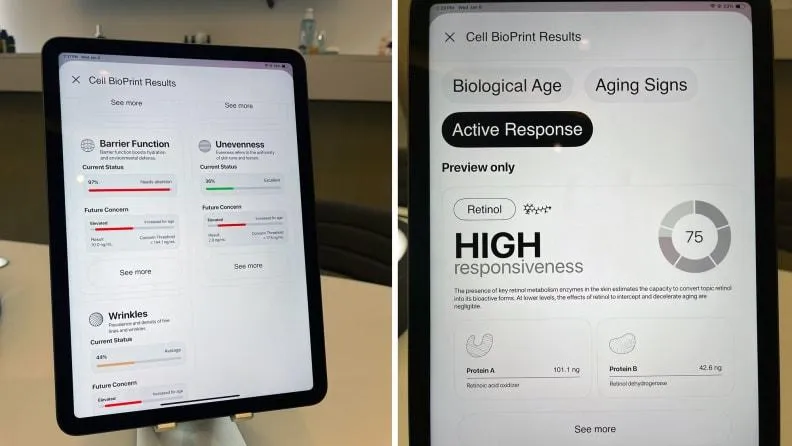
Cell BioPrint results showing biological age, visible ageing signs and predicted skin response.
The idea is to move beyond simply looking at the surface and instead examine molecular characteristics that may help describe how the skin is ageing and potentially how it might respond to particular ingredients. L'Oréal Research & Innovation
That represents a different model of skincare.
Instead of simply looking at the skin, making a visual assessment and recommending a product, the longer-term model could become:
sample → measure → identify biological characteristics → treat → measure again.
The same principle could eventually extend beyond skincare products. If biological measurements become reliable enough, they could potentially be used to track how skin changes after interventions, distinguish different patterns of ageing and help determine which treatments are actually changing the underlying biology rather than simply improving its appearance.
We're not there yet. But the direction is becoming clearer.
We have spent decades developing better ways to see ageing.
We're now developing better ways to measure it.
And that leads to the next question.
What happens when measurement becomes sophisticated enough that we can start building the thing we're measuring?
That's where I'm going next.
C·🌷
Next in Cesence
What happens when we stop measuring ageing skin and start trying to build it?
Research notes
Skin-specific epigenetic clock Bienkowska et al., 2024 Development of an epigenetic clock to predict visual age progression of human skin. Full study
Non-invasive skin methylome profiling Banila et al., 2023 A noninvasive method for whole-genome skin methylome profiling. Full study
Non-invasive skin biological-age assessment Menendez Vazquez et al., 2025/2026 Epigenetic age predictors for non-invasive assessment of human skin. Full study
Machine learning and skin-age estimation McMullen et al., 2025 Machine learning methods for determining skin age: A systematic review. Full review
Cell BioPrint L'Oréal Research & Innovation Cell BioPrint: The Future of Personalized Skin Care. Research overview
Human skin bio-engineering L'Oréal Research & Innovation Human Skin Bio-Engineering. Research overview